Soma Community Church

Gospel/ Family/ Mission

  • 10 Year Anniversary
  • New Here
    • FAQ/ Location
    • About Us
    • What We Believe
    • Our Leadership
    • Our Name
    • Affiliations
  • Get Involved
    • Baptism
    • Rooted (College Ministry)
    • Covenant Membership
    • Events
  • Blog
  • Sermons
  • Giving
  • Contact Us

Should Christians celebrate Juneteenth?

“Anytime, anytime while I was a slave, if one minute’s freedom had been offered to me, and I had been told I must die at the end of that minute, I would have taken it—just to stand one minute on God’s earth a free woman—I would.” – Elizabeth Freeman (also known as Bet or MumBet, was the first enslaved African American to file for and win a freedom suit in Massachusetts.)

During the Civil War, President Abraham Lincoln issued the Emancipation Proclamation on September 22, 1862, with an effective date of January 1, 1863. It declared that all enslaved persons [only] in the Confederate States of America in rebellion and not in Union hands were to be freed.  There is no one reason why there was a 2½-year delay in letting Texas know about the abolition of slavery in the United States. Some accounts place the delay on a messenger who was murdered on his way to Texas with the news, while others say the news was deliberately withheld. Despite the delay, slavery did not end in Texas overnight, after New Orleans fell, many slavers traveled to Texas with their slaves to escape regulations enforced by the Union Army in other states.  [Read more…]

Sanctity of life and MLK

Over the last few years of my life, around this time of year, I have been placed in a conundrum in my life. Every January the celebration of Martin Luther King’s (MLK) Birthday and the Sanctity of Life Sunday seem to fall on the same Sunday.

[Read more…]

Saying “N****r” shouldn’t get Paula Deen fired

**I try hard not to speak about current events as anything but an observer, but this one has just become out of control. So this week I want to comment on the Paula Deen debacle and lend some clarity.

Warning, there maybe some language in this post that could be considered offensive.**

I have a guilty pleasure, cooking shows. I love “the Food Network (FN)”, “Top Chef” and others. I have learned so much that has served to advance my cooking skills. Paula Deen has been among the host that have given me a better understanding of Southern culture and cooking. I was initially surprised as the next person to hear of Mrs. Deen’s comments, use of the word “Nigger” and subsequent firing by the FN and other sponsors. What further concerned me was the instant “I support Paula Deen” Facebook pages and multiple post showing support for a women who used a word that, as a society, we have considered repugnant for many decades (though in my humble opinion not long enough). Additionally, I began to laugh when I read post from my friends comparing Deen’s situation to movies that say “Nigger” or “nigga (not that this word is much better)” a ridiculous amount of times (e.g. Django Unchained). I truly believe that Paula Deen should not be fired for admitting that she called someone a nigger 30 years ago but you should really read the deposition for yourself. The whole thing is now out and it is a pretty long read and damning read, here are some of the highlights (lowlights) and why I believe she was really fired.
  • She was accused (in a lawsuit) of only hiring only Caucasians to work in the front of the restaurant:

“Bubba [her brother] and I, neither one of us, care what the color of your skin is or what is between your legs, it’s what’s in your heart and in your head that matters to us.”

  • The transcript mentions employee complaints about Deen’s brother looking at pornography at the restaurant during operating hours and forcing other employees to look at it as well. In direct response to questions about this, Deen said:

“I know all men in my family at one time or another, they’ll tell each other, ‘look what so and so sent me on my phone,’ you know. It’s just men being men.”

  • In response to questions about whether or not she’d have a problem with her brother looking at porn at work, Deen said:

“If somebody sent him something and he pulled it up and looked at it, no, I would not persecute him for that. … Bubba, I don’t think, would ever do that if he thought there was somebody in the room that he — it would insult.”

  • She did respond to a question about when it’s acceptable to use the N-word and Deen said:

“We hear a lot of things in the kitchen. Things that they — that black people will say to each other.  If we are relaying something that was said, a problem that we’re discussing, that’s not said in a mean way.  What about jokes, if somebody is telling a joke that’s got —It’s just what they are, they’re jokes.”

The continuation of this line of questioning is rather disturbing.  Even Macklemore and Eminem understand that in today’s America there is not a nice way to call a African American a nigger, yet Deen proceeded to find that medium.  This her response to the lawyer asking her to give and example of how to use the word nigger in a nice, joking way after she state that she could:

“That’s — that’s kind of hard. Most — most jokes are about Jewish people, rednecks, black folks. Most jokes target — I don’t know. I didn’t make up the joke, I don’t know. I can’t — I don’t know.”

There is not a nice way to tell a joke with the word “nigger” in it, trust me I have heard my fair share and not one of them is funny.

  • The most repugnant part of the deposition was Deen’s description of a “[pre] Civil Wars style Southern plantation wedding” she wanted for her brother.  She was reportedly inspired by a restaurant with nicely dressed, middle-aged black waiters dressed up as slave caricatures. When asked by the questioner in the deposition whether the race of the waiters mattered, Deen said, “Well, that’s what made it.”  the very suggest that slaves could be a quaint scenic touch at a wedding is deplorable to say the least.

Listen, if you really want to please go and read the whole deposition .  After i did I came to the to the conclusion that as a private company I would not want someone who acts in the manner that she has and continues to defend it to represent my company.  What about forgiving and forgetting? Honestly, I am all for forgiving but I also understand that we all must deal with the consequences of our actions (good or bad) and unfortunately we must let Mrs. Deen and her brother walk that path.  She is a public figure and she has to deal with this publicly.  If you want to talk about the numbers of celebrities, actors, pastors, politicians of all races that make stupid comments I will submit that you are deflecting from the real reason for her release and ask you to please read the deposition.

As I began I really meant what I said, I do not think she should be fired for calling a robber a nigger 30+ years ago while working at a bank but I the more I dig I see a national and cultural conversation that need to happen, especially within the church.  I think another blogger said it the best when she said, “If our country ever wants to heal from the racism of our past, [we have] to stop denying that it’s still an issue. We need to own it. To step up and start a national conversation about race. That starts by being honest.”

Honestly, these are just my thoughts and opinions, what say you?  I look for ward to the conversation!

Please like this post and share it on Facebook and/or Google + and follow me on Twitter

Black Church: Rhythm

It is Black History Month, and every year I try to celebrate by writing a series of articles that particularly pertain with my culture and her expression through Christ.  I must admit this relationship has not always been the most healthy for me, but over the years I have come to the conclusion of loving the heritage and culture I have been given.  Additionally, I wanted to start off by talking about some things I love about this culture.  Notice I am saying culture, this is not a racial thing because there are only two races: those who are saved and those who are not.  I just want to clarify this as I will intersperse those words throughout my writing moving forward.

RHYTHM

The poet Leopold Sedar Senghor, first president of the republic of Senegal, stated that rhythm is the “organizing force” that makes the black style.  Both Africans and African Americans use rhythm (not exclusively but uniquely)  to articulate their moral, theological, and philosophical beliefs. Rhythm, the essential and central element in black music, philosophically communicates “religious” experience in African and African-American culture and helps its ritual participants reach “communitas.”

Rhythm is particularly significant for rap because it gives rap its unique movement and momentum.  Tricia Rose sucessfully demonstrated through her research that the lowest or fattest beats in a rap song are likely the ones that the most philosophically significant or emotionally charged. Whereas Western music finds its uniqueness in melodic and harmonic structures, African American music finds its uniqueness in rhythmic and percussive structure.

I love the sounds inspired by the black community, whether those sounds come from gospel choirs, blues, Jazz, R & B, Soul, Neo-Soul, rap, or hip-hop.  Allow me to list three ways in which I am grateful.

  1. Gospel choirs: I grew up in a church that did them well.  The emotion, swaying, passion, heart are all things I sometimes miss on a Sunday morning.  Additionally, the spirituals, these are something that as I have grown older have grown closer to my soul.  The pure angst behind every word is still very evident to this day.
  2. Christian rap/Hip hop:  One of the most creative and faithful forms of worship to have arisen in recent years is Christian rap, with rappers like Shai Linne, Trip Lee, and Lecrae unleashing some of the most powerful and profound lyrics available in contemporary Christian Music today. I have to be honest this music saved me as I first became a Christian because most of CCM is acoustic guitar driven “soft rock” or ballets and I could not stand it.  May their tribe increase (I wish I were part of the tribe but it is not my calling).
  3. Mainstream Rap/Hip-hop:  While there is so much with which I disagree in mainstream rap and hip hop, those art forms within themselves have served as powerful venues to entire communities to express their beliefs, feelings, and values (both social and political.  Rap itself is an acronym for Rhythm and Poetry and gains its roots in pre-slavery African and serves a basis for most forms of “American”music that we know today.  Even when these artists’ music are consciously and profoundly non-Christian, the Christian community is well served to pay attention to these art forms as a way of loving and understanding a community that is usually so misunderstood yet rich with insight.

Black Genocide: the new racial slavery

**Update 2013: This post is from February 2012 but in light of Rev. Dr. Martin Luther King Jr. Birthday, President Obama’s Inauguration and the 40th anniversary of Roe vs. Wade I felt compelled to re-post this one so we can look at the reality of racial slavery in the United States.  I would love to hear what you think in the comments below.**

Unlike last year I have chosen to largely avoid the subject of Black History month (for many reasons), but if you would like to read those post please click here.  I did want to talk a subject that I did not have the opportunity to address last year and I feel is truly important to the Black community at-large.  The subject is abortion.  So let me put all of my cards on the table.  I am pro-life, anti-abortion, anti-choice or however you would like to frame it.  My view on this subject is shaped mainly by the Bible but also by my experience with family, friends, pastors, and professors that have had or have been the target of an abortion.  I am not sure that I can change your mind, or if that is even my purpose but my intent is to inform people of the realities of this issue.

Last February (Black History Month) this billboard was erected in the SoHo district of New York near one of Planned Parenthoods (PP) 3 located in the city.  Immediately there was a great outcry not only from PP but also the Black community.  To be completely honest I was taken back by the back lash. So here is some history.

We do not want the word to get out that we want to exterminate the Negro population, and the minister is the man who can straighten out that idea if it ever occurs to any of their more rebellious [church] members.

This quote is from Margaret Sanger who was a “reproductive rights advocate” and eventual founder of PP and was aware of concerns that birth control would pose a threat to the Black community.  Consequently, she was determined to alleviate these concerns by involving the African American community (specifically civic leaders, pastors) in the formation of birth control clinics in the South.  The quote above comes from a letter that Sanger wrote to Dr. Clarence J. Gamble, one of the financial backers of the birth control movement.  In the letter, Sanger argued that African American doctors needed to be employed at birth control clinics.  She felt that it was important to employ black doctors and social workers in order for patients to feel that the clinics represented their community.  When the Birth Control Federation of America became Planned Parenthood Federation of America in 1942, Sanger established the Division of Negro Service [context] to oversee outreach to the African American community nationally.  These seem nominal until you find that Sanger aligned herself with the eugenicists whose ideology prevailed in the early 20th century.  Eugenicists strongly espoused racial supremacy and “purity,” particularly of the “Aryan” race.  Eugenicists hoped to purify the bloodlines and improve the race by encouraging the “fit” to reproduce and the “unfit” to restrict their reproduction. They sought to contain the “inferior” races through segregation, sterilization, birth control and abortion.  Sanger embraced a certain type of eugenics called Malthusian eugenics. Thomas Robert Malthus, a 19th-century cleric and professor of political economy, believed a population time bomb threatened the existence of the human race.  He viewed social problems such as poverty, deprivation and hunger as evidence of this “population crisis.”  Malthus’ disciples believed if Western civilization were to survive, the physically unfit, the materially poor, the spiritually diseased, the racially inferior, and the mentally incompetent had to be suppressed and isolated—or even, perhaps, eliminated. His disciples felt the subtler and more “scientific” approaches of education,contraception, sterilization and abortion were more “practical and acceptable ways” to ease the pressures of the alleged overpopulation.

Why do I bring all of this old stuff up you may ask?  What does this have to do with PP today?

History can give us a great view of the trajectory of any person or organization.  Can a person or organization change?  Yes, I have, by God’s grace repented (implying a 180 degree change) and I am being remade through the grace of God.  Though PP has tried to distance themselves from Sanger the truth is that her mission seems to be alive ad well.  Whether on purpose or not I do not claim to know.

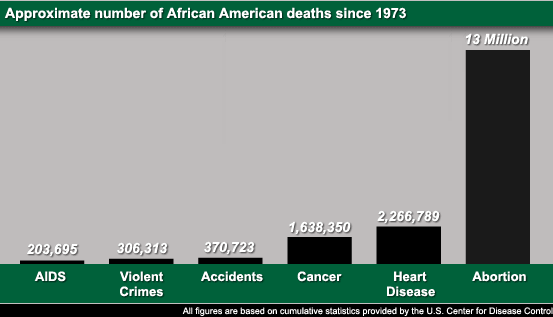
The Supreme Court in the Dred Scott case of 1857 held that Black slaves were property without rights as free persons, yet today we view that as unthinkable; so also even though the Supreme Court in the Roe v. Wade case of 1973 did not give the unborn the rights of free persons, nevertheless the day may come when that too is viewed as unthinkable. Racism might—and often did—result in the killing of innocent humans; in our history, it often did. But abortion always results in the killing of innocent humans. Between 1882 and 1968, 3,446 [known] Black people were lynched in America. Today more Black babies are killed by abortionists every three days than all who were lynched in those years (Life Education and Resource Network).

Today 78% of Planned Parenthood clinics are in minority communities. John Ensor takes this as the crucial challenge of the pro-life, crisis pregnancy center movement: Go to the urban centers. Here is what he says:

To date, the pregnancy center movement has grown mostly in rural and suburban areas. The great challenge now facing us is to respond to the abortion industry’s dominant business strategy of abandoning rural and suburban abortion facilities and targeting urban neighborhoods. For example, Planned Parenthood closed 17 abortion facilities in 2004. But they sold 20% more abortions. How did they do this? By targeting minority neighborhoods in major cites. Currently, 94% of America’s abortion facilities are in cities. And African-American women, who make up 13% of the female population account for 36% of all abortions.  Latino-American women makeup another 13% of the female population, but account for another 20% of all abortions. (See Susan Enouen, “Planned Parenthood Abortion Facilities Target African American Communities.”)

In other words, the de facto effect (I won’t call it the main cause, but net effect) of putting abortion clinics in the urban centers is that the abortion of Hispanic and Black babies is more than double their percentage of the population. Every day 1,300 black babies are killed in America. Seven hundred Hispanic babies die every day from abortion. Call this what you will—when the slaughter has an ethnic face and the percentages are double that of the white community, something is going on here that ought to make the lovers of racial equality and racial harmony wake up.

I simply want you to know where I am going, so that no one will say I made this association between abortion and racism in a sly or subtle way. It is not subtle. It is open and intentional and, I hope to show, justified. May God make the support of abortion in America and around the world as unthinkable as support for racism.

I don’t expect to escape misunderstanding or criticism for this message. But  few attacks might be avoided by quoting Randy Alcorn whose view I share:

I do not believe that most people who support abortion rights are racists, any more than I believe there are no racists among pro-lifers. I am simply suggesting that regardless of motives, a closer look at both the history and present strategies of the pro-choice movement suggests that “abortion for the minorities” may not serve the cause of equality as much as the cause of supremacy for the healthy, wealthy and white. (Eternal Perspectives, Sept.-Oct. 1993, p. 9)

Again my aim is to associate abortion and racism, not to equate them. Whether the association is justified, you will decide. It’s not a biblical declaration; it’s a cultural observation.

Listen, I know that abortion is a very touchy subject, and talking about it can result in anger and accusations.  Therefore, I pray that in this article I did not offend anyone needlessly or carelessly.  As a Christian, I believe abortion is wrong, but I will not point an angry condemning finger at anyone who has had an abortion.  The choice to have an abortion is not an easy or flippant decision.  It also is a decision that has been made by many of my friends and family, and had in no way diminish my love for any of them.

Others, I suspect, may be tempted to dismiss my comments because I am a Christian as well as a man.  I can only hope that if this is you that you will not do that and listen to the facts presented here.  Others may assume that I will try to condemn them and then use the Bible to bash and ridicule.  This was not my intent in any way, shape or form.  I reference the Bible, not as a club, but as a source of forgiveness and encouragement.  No one is cut off from Christ because of past sin – any past sin. What cuts a person off from Christ and the fellowship of his people is the endorsement of past sin. For the repentant there is forgiveness and cleansing and hope.” 2 Corinthians 7:9,10 says:

I now rejoice, not that you were made sorrowful, but that you were made sorrowful to the point of repentance; for you were made sorrowful according to the will of God, in order that you might not suffer loss in anything through us. For the sorrow that is according to the will of God produces a repentance without regret, leading to salvation; but the sorrow of the world produces death.

Reconciliation to God, through the blood of Jesus Christ, is the only way to overcome the tragedy of abortion, and though the sorrow of past sins can linger, the penalty will be forever lifted. If you have received this forgiveness, let the world know, and be a voice of warning to those thinking of talking the same path as you.

A knock at midnight

On February 4, 1968, these resounding words were heard at the Ebenezer Baptist Church in Atlanta, Georgia:

If any of you are around when I have to meet my day, I don’t want a long funeral. And if you get somebody to deliver the eulogy, tell them not to talk too long… Tell them not to mention that I have a Nobel Peace Prize—that isn’t important. Tell them not to mention that I have three or four hundred other awards—that’s not important. Tell them not to mention where I went to school… say that I was a drum major for justice. Say that I was a drum major for peace. I was a drum major for righteousness. And all of the other shallow things will not matter.  I won’t have any money to leave behind. I won’t have the fine and luxurious things of life to leave behind. But I just want to leave a committed life behind.  And that’s all I want to say.

Today, is the birthday of a man who so eloquently spoke those words.  I wanted to honor his memory, his trials, his triumphs, and his accomplishments.  The reluctant dreamer who dared to speak out against injustice, who dared to trod into hostile and violent territories for [racial] equality, who dared to preach hope for the hopeless.

Rev. Dr. Martin Luther King Jr. delivered many speeches and sermons in his short time in the national spotlight. Certainly, his words will be forever enshrined in print, audio, and even electronic materials. I have been to the mountaintop, I Have a Dream, Beyond Vietnam, How Long Not Long, are only a few titles was well known speeches and sermons delivered by him.  Each of them are inspiring with a very sharp edge if you are paying attention.   I think about the world in which we now live – some 84 years after his birth – there is one speech by Dr. King is both timely and powerful.
The sermon was called “A Knock at Midnight” and it is about the parable in Luke 11:5-6 where a lonely traveler knocks at someone’s door around the midnight hour to ask for food for a friend. What would you do? Dr. King says,

“It is also midnight within the moral order. At midnight colors lose their distinctiveness and become a sullen shade of gray. Moral principles have lost their distinctiveness. For modern man, absolute right and wrong are a matter of what the majority is doing. Right and wrong are relative to likes and dislikes…”

In listening to the words of this sermon,  I could not help but think  how prophetic he was.  His words are still very relavent today and I want to leave you words he spoke that night that should stir something deep within our souls today.

If the church does not recapture its prophetic zeal, it will become an irrelevant social club without moral or spiritual authority….But if the church will free itself from the shackles of a deadening status quo, and, recovering its great historic mission, will speak and act fearlessly and insistently in terms of justice and peace, it will enkindle the imagination of mankind and fire the souls of men, imbuing them with a glowing and ardent love for truth, justice, and peace.

Listen to the full sermon here or watch a clip below

[youtube=http://www.youtube.com/watch?v=0JFLjwAYHks]

  • 1
  • 2
  • Next Page »

Soma Community Church

804 Fairmount Blvd
Jefferson City, MO 65109
(573) 635-4832

Click Here for Mailing Address

Get Connected

  • 10 Year Anniversary
  • New Here
    • FAQ/ Location
    • About Us
    • What We Believe
    • Our Leadership
    • Our Name
    • Affiliations
  • Get Involved
    • Baptism
    • Rooted (College Ministry)
    • Covenant Membership
    • Events
  • Blog
  • Sermons
  • Giving
  • Contact Us

Copyright © 2025 ·SOMA Community Church · Website by Megaphone Designs