Soma Community Church

Gospel/ Family/ Mission

  • 10 Year Anniversary
  • New Here
    • FAQ/ Location
    • About Us
    • What We Believe
    • Our Leadership
    • Our Name
    • Affiliations
  • Get Involved
    • Baptism
    • Rooted (College Ministry)
    • Covenant Membership
    • Events
  • Blog
  • Sermons
  • Giving
  • Contact Us

Totally like whatever, you know?!?

This video goes out to all of the Young Professionals and College -aged people I know.  I understand that we sometimes become frustrated in conversation but this piece sums why I ask what I ask of you.  Know what you believe and be able to articulate it with like conviction you know…and stuff (?)

[youtube=http://www.youtube.com/watch?v=LGAMd-tT6fQ&feature=player_embedded#at=152]
Preach the Gospel always, when necessary use words?

This quote, or some variation of it, is attributed to St. Francis of Assisi, is one of the many threats to evangelism today.  Now to be fair to St. Francis, there’s no evidence that he himself ever said this quote. It’s not in any of his writings and is a little pithy for someone of the Franciscan order.  Although it does bear some resemblance to a line in his 1221 Rule:
“Let all the brothers, however, preach by their deeds” – Chapter XVII.

Even if St. Francis didn’t exactly speak the above saying, it certainly is Franciscan in style and a wonderful sentiment. Actions often do speak louder than words. Quite often, the only Gospel any non-Christian is going to “read” is the life of a Christian they encounter on their way through life. A life lived in stark contrast to the standards of the world speaks much more loudly than any moralizing sermon.

On the other hand it plays to our fear of speaking about Jesus, and to our sense of weakness and insufficiency to the task. I can’t help but wonder how often we use this pithy saying as an excuse for our lack of efforts in evangelism. It’s all very well saying that we prefer to preach the Gospel with our actions, but what exactly are these actions of ours which are preaching the Gospel?  Do we regularly make a conscious effort in our actions to preach the Gospel?  How exactly does preaching the Gospel with our actions make us different than the Mormon, Jew, Muslim, Buddhist, Hindu, etc?  Are they not more consistently “better people”?
As you can see I believe this line of thinking and action is fundamentally flawed at so many levels.  Let me deal with few ways I see this. Let me say whether St. Francis said it, or whether it contains useful teaching isn’t my point. My concern is the way it is applied.

First, why do you need to tell me not to use words?
It is endemic of assumed evangelicalism that we forget that each of us how know about Jesus did once hear about him. People insist on preaching that we need no preaching, this is very like the postmodern wordsmiths who proclaim the meaningless of words – and yet expect their own words to be clearly understood! People complain about indoctrination, but indoctrinating just means teaching – and everyone gets taught, and everyone has doctrines.

Second, the Bible makes it clear that Words are always necessary.
The very existence of the Bible indicates God’s express intent to communicate with words. But more than that that it is by the speaking of the good news about Jesus that people will come to believe. In a society that still carries a little Christian-Culture we might forget our need to hear – but the fact remains that what we know is only known because we have been told. It is by God’s spoken word that we know anything definitive about people. The first thing God did was speak, and his people are told to speak too. Paul’s final word to Timothy (2 Tim 4:2) wasn’t do the washing up, it was ‘preach the word’.

Third, using Words is not an alternative to living the life
Those who prohibit use of words do so in favour of living distinctively. This is a false distinction. It is not an option as to either preach or live, both are required! A related issue is, what does a life look like that is changed by Jesus. My suspicion is that its more than just moral respectability – we are probably more compromised with our western culture than we dare to admit. Without words people will not guess that we are Christian- since they will not know what Christian is. With only words our faith will not carry half the impact – Christians should be at the forefront of making the most of life, living it the way it should be, in the arts, creativity, justice and joy… for the glory of the gospel of Christ. How that works in practice is something we need to wrestle with! If we follow the ‘great comission’ in Matthew 28 the result will be both preachers and teachers but also those who live in accordance with Jesus’ teaching. Live and speak.

Fourth, Jesus told us to preach, disciple and teach.
All of these things require speaking and using words. The word revealed message of Jesus has to be verbally explained. The apostles in Acts prove, persuade and convince people about Jesus, and while it takes God to open eyes we are still to present the case. We should use words with care and seriousness that reflects what we’re speaking about. Preaching is not an excuse for excessive confrontation or any rudeness in our explaining about Jesus. We should be clear and respectful, though we will inevitably cause some offense. (c.f. 2 Timothy 4:2, or Matthew 28:19-20)

Fifth, yes, the message is offensive and foolish.
Often we appeal to St. Francis’ words because we look at the messages of the world and think they are superior to ours… ultimately God gives us wisdom to confound the world’s wisdom, and wisdom which Jesus himself says will not be understood by lots of people. People are blind to Jesus message, blinded by sin and by satan. But when the gospel is spoken God re-creates and heals this blindness. 1 Corinthians 1:18 shows the folly of the gospel that generations have rejected because it didn’t suit their itching ears (c.f. 2 Timothy 4:4).

Sixth, even if preaching is illegal we must do it.
The first apostles were banned from speaking about Jesus, they could not comply with this kind of request. Preaching the gospel might mean we end up in prison – that is just part of the deal. (c.f. Acts 4:19-20).

The purpose of good deeds is not to enhance a verbal proclamation, the purpose of good deeds is to glorify God and love others.  That’s it. However, a potential benefit of good deeds is that people will ask questions and become receptive to a verbal explanation of the gospel.  Words are still necessary and this is an often missed, yet powerful point to the St. Francis of Assisi quote. “When necessary, use words” means that words are often necessary.

Imagine someone asking you a question, then you stare at them in silence. Who knows what they would interpret from your silence. For better or worse, words are required to explain concepts and provide answers.

Therefore, an appropriate distinction is between verbal proclamation (word) and social service (deed). Yet there is no inherent superiority or inferiority to either. They seamlessly integrate together to equal effective ministry. Good deeds prompt questions. This is why Peter instructed his readers to do good and then followed by saying, “Always be prepared to give an answer to everyone who asks you to give the reason for the hope that you have (1 Peter 3:15).” If we do good deeds then we need to be ready to say why we do them. The questions will come and if not, we have to ask ourselves what is wrong when no one asks questions to which the gospel is the answer.

Why religion is silly…


“Religion is the default mode of the human heart”

– Martin Luther

You have heard me for years say that religion is silly and here is why.  Religion seeks to answer a very important question, “How can we who are unholy and unrighteous be declared holy and acceptable in the sight of a holy and righteous God?”  Religion asks the right question and provides the wrong answer.  They say, “What should we do to make ourselves holy? What should we do to make ourselves righteous?”  While asking these questions they miss Jesus, who makes them holy and makes them righteous.  While they build traditions and rules and regulations in an effort to perform their way to pleasing God. I just wanted to show you the extreme version of religion in our world and how it just becomes silly.   We’re all prone to go toward religion. And in varying ways, at varying times, to varying degrees, we’re all religious.  So when we read about religious people, we can’t simply criticize them. We also need to examine ourselves.

“Religious paper apologizes for erasing Clinton from iconic photo” By Jessica Ravitz, CNN

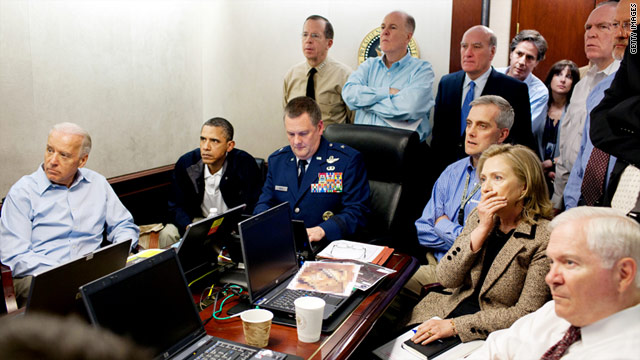
(CNN) – Faith has outweighed fact at Di Tzeitung, a Hasidic newspaper based in Brooklyn, New York. The ultra-Orthodox Jewish publication ran a doctored copy of the iconic “Situation Room Photo” last Friday – you know, the one taken of President Barack Obama and his national security team during the raid on Osama bin Laden’s compound. Scrubbed from the picture: the two women in the room. It’s as if Secretary of State Hillary Clinton, with her hand clasped over her mouth, and Audrey Tomason, director of counterterrorism, weren’t there and weren’t part of history.

Here they are for comparison:

  [I]n a written statement issued Monday afternoon by Di Tzeitung, the newspaper said that its decision to leave women out of photos is religiously mandated and that the right to do so is protected by the U.S. Constitution. “The First Amendment to the Constitution guarantees freedom of religion. That has precedence even to our cherished freedom of the press,” the statement said.  “Publishing a newspaper is a big responsibility, and our policies are guided by a Rabbinical Board. “Because of laws of modesty, we are not allowed to publish pictures of women, and we regret if this gives an impression of disparaging women, which is certainly never our intention,” it continued. “We apologize if this was seen as offensive.”

Parable of the Madman

Have you not heard of that madman who lit a lantern in the bright morning hours, ran to the market place, and cried incessantly: “I seek God! I seek God!”—As many of those who did not believe in God were standing around just then, he provoked much laughter. Has he got lost? asked one. Did he lose his way like a child? asked another. Or is he hiding? Is he afraid of us? Has he gone on a voyage? emigrated?—Thus they yelled and laughed

The madman jumped into their midst and pierced them with his eyes. “Whither is God?” he cried; “I will tell you. We have killed him—you and I. All of us are his murderers. But how did we do this? How could we drink up the sea? Who gave us the sponge to wipe away the entire horizon? What were we doing when we unchained this earth from its sun? Whither is it moving now? Whither are we moving? Away from all suns? Are we not plunging continually? Backward, sideward, forward, in all directions? Is there still any up or down? Are we not straying, as through an infinite nothing? Do we not feel the breath of empty space? Has it not become colder? Is not night continually closing in on us? Do we not need to light lanterns in the morning? Do we hear nothing as yet of the noise of the gravediggers who are burying God? Do we smell nothing as yet of the divine decomposition? Gods, too, decompose. God is dead. God remains dead. And we have killed him.

“How shall we comfort ourselves, the murderers of all murderers? What was holiest and mightiest of all that the world has yet owned has bled to death under our knives: who will wipe this blood off us? What water is there for us to clean ourselves? What festivals of atonement, what sacred games shall we have to invent? Is not the greatness of this deed too great for us? Must we ourselves not become gods simply to appear worthy of it? There has never been a greater deed; and whoever is born after us—for the sake of this deed he will belong to a higher history than all history hitherto.”

Here the madman fell silent and looked again at his listeners; and they, too, were silent and stared at him in astonishment. At last he threw his lantern on the ground, and it broke into pieces and went out. “I have come too early,” he said then; “my time is not yet. This tremendous event is still on its way, still wandering; it has not yet reached the ears of men. Lightning and thunder require time; the light of the stars requires time; deeds, though done, still require time to be seen and heard. This deed is still more distant from them than most distant stars—and yet they have done it themselves.

It has been related further that on the same day the madman forced his way into several churches and there struck up his requiem aeternam deo. Led out and called to account, he is said always to have replied nothing but: “What after all are these churches now if they are not the tombs and sepulchers of God?”

Source: Friedrich Nietzsche, The Gay Science (1882, 1887) para. 125

What do you think when you read this?

A simple message for Christians and non-Christian friends

This is not easy to post because it may offend many of you, but I do not write on this blog, live my life, say what I say, for anyones sake, only for the Glory of God.  Please watch the video and take a second to evaluate what he said and whether it’s true.  Then search your heart and respond.

“The same sun that hardens the clay also softens the wax.”  -Puritan Proverb

[youtube=http://www.youtube.com/watch?v=587JL4Kzfu0]

Who is Jesus?

The greatness of God is most clearly displayed in his Son. And the glory of the gospel is only made evident in his Son. That’s why Jesus’ question to his disciples is so important: “Who do you say that I am?”

The question is doubly crucial in our day because not every Jesus is the real Jesus. Almost no one is as popular in this country as Jesus. Hardly anyone would dare to say a bad word about him. Just look at what a super-fly friendly dude he is over there. But how many people know the real Jesus?

  • There’s the Republican Jesus who is against tax increases and activists judges, for family values and owning firearms.
  • There’s Democrat Jesus who is against Wall Street and Wal-Mart, for reducing our carbon footprint and printing money.
  • There’s Therapist Jesus who helps us cope with life’s problems, heals our past, tells us how valuable we are and not to be so hard on ourselves.
  • There’s Starbucks Jesus who drinks fair trade coffee, loves spiritual conversations, drives a hybrid and goes to film festivals.
  • There’s Open-minded Jesus who loves everyone all the time no matter what, except for people who are not as open-minded as you.
  • There’s Touchdown Jesus who helps athletes fun faster and jump higher than non-Christians and determines the outcomes of Super Bowls.
  • There’s Martyr Jesus, a good man who died a cruel death so we can feel sorry for him
  • There’s Gentle Jesus who was meek and mild, with high cheek bones, flowing hair, and walks around barefoot, wearing a sash and looks very German.
  • There’s Hippie Jesus who teaches everyone to give peace a chance, imagine a world without religion, and helps us remember all you need is love.
  • There’s Yuppie Jesus who encourages us to reach our full potential, reach for the stars, and buy a boat.
  • There’s Spirituality Jesus who hates religion, churches, pastors, priests, and doctrine; and would rather have people out in nature, finding the god within and listening to ambiguously spiritual musical.
  • There’s Platitude Jesus, good for Christmas specials, greeting cards, and bad sermons; he inspires people to believe in themselves, and lifts us up so we can walk on mountains.
  • There’s Revolutionary Jesus who teaches us to rebel against the status quo, stick it to the man, and blame things on the “system.”
  • There’s Guru Jesus, a wise, inspirational teacher who believes in you and helps you find your center.
  • There’s Boyfriend Jesus who wraps his arms around us as we sing about his intoxicating love in our secret place.
  • There’s Good Example Jesus who shows you how to help people, change the planet, and become a better you.

And then there’s Jesus Christ, the Son of the living God. Not just another prophet. Not just another Rabbi. Not just another wonder-worker. He was the one they had been waiting for: the Son of David and Abraham’s chosen seed, the one to deliver us from captivity, the goal of the Mosaic law, Yahweh in the flesh, the one to establish God’s reign and rule, the one to heal the sick, give sight to the blind, freedom to the prisoners and proclaim good news to the poor, the lamb of God come to take away the sins of the world.

This Jesus was the Creator come to earth and the beginning of a new creation. He embodied the covenant, fulfilled the commandments, and reversed the curse. This Jesus is the Christ that God spoke of to the serpent, the Christ prefigured to Noah in the flood, the Christ promised to Abraham, the Christ prophesied through Balaam before the Moabites, the Christ guaranteed to Moses before he died, the Christ promised to David when he was king, the Christ revealed to Isaiah as a suffering servant, the Christ predicted through the prophets and prepared for through John the Baptist.

This Christ is not a reflection of the current mood or the projection of our own desires. He is our Lord and God. He is the Father’s Son, Savior of the world, and substitute for our sins–more loving, more holy, and more wonderfully terrifying than we ever thought possible.

[youtube=http://www.youtube.com/watch#!v=YNJ5oi1cw2I]

(What proceeded is adapted from the end of the talk on the “Life of Christ” that Kevin DeYoung gave at the Next 2009 Conference)

HT: Kevin DeYoung

  • « Previous Page
  • 1
  • 2
  • 3
  • Next Page »

Soma Community Church

804 Fairmount Blvd
Jefferson City, MO 65109
(573) 635-4832

Click Here for Mailing Address

Get Connected

  • 10 Year Anniversary
  • New Here
    • FAQ/ Location
    • About Us
    • What We Believe
    • Our Leadership
    • Our Name
    • Affiliations
  • Get Involved
    • Baptism
    • Rooted (College Ministry)
    • Covenant Membership
    • Events
  • Blog
  • Sermons
  • Giving
  • Contact Us

Copyright © 2025 ·SOMA Community Church · Website by Megaphone Designs