Soma Community Church

Gospel/ Family/ Mission

  • 10 Year Anniversary
  • New Here
    • FAQ/ Location
    • About Us
    • What We Believe
    • Our Leadership
    • Our Name
    • Affiliations
  • Get Involved
    • Baptism
    • Rooted (College Ministry)
    • Covenant Membership
    • Events
  • Blog
  • Sermons
  • Giving
  • Contact Us

Rob Bell is not a universalist…

Update: A careful and devastating review of Bell’s book can be read here (it is a PDF file).

Note: I’ve added an update at the end of this post.

… let me explain.  I know that many of you that read this blog are familiar with the name above.  As a college student I was first exposed to Rob Bell and his thought provoking questions through his Nooma videos and multiple books.  I remember when I first encountered Nooma I felt they were a breath of fresh air in what was (in my opinion) silly evangelical media.  I remember being taken back by his speaking ability, his thoughts, and his creativity.  Someone who thinks like me (way outside the box), is willing to challenge evangelical norms and not just accept what he was spoon fed.

I also remember when I was just beginning my theological education that multiple professors warned me about Rob Bell and other emerging types.  I heard them, but I defended him and others vociferously and for the most part most of the pastors and teachers I defended have proven to be extremely orthodox in their theology.

Well if you have not heard (or just don’t care) Rob Bell is in the center of a pretty large brouhaha about where he stands theologically.  Many people are throwing around the words “heretic”, and “universalist” and it is getting the attention of the likes of USA Today, Good Morning America, NY Times, CNN, Fox News and MSNBC.  Honestly, I think this is a good thing and not a bad one.

I also know many of us younger Christ followers barely have any stomach for controversy, let alone strong words about a serious topic.  If there is no way to be simultaneously bold and humble; if there is no way to be a gentle, caring person while still speaking in clear tones about hurtful error; if there is no way to correct those who oppose sound doctrine without being a moral monster; if there’s no way to love truth and grace at the same time, then there’s no way to be a biblical Christian.  Let me be clear, not every judgment is sinful and not every truth is cruel.

It seems that most people I talk have expierieced Rob Bell’s books and videos and this what makes this issue so pressing.  Clarity on the important issues he raises (and misunderstands) is absolutely necessary.  I think the clear and overwhelming rejection of Bell’s views by orthodox Christians (with very lengthy responses) indicates that this is clearly in error on several points.  I think Lisa Miller of Newsweek frames this whole brouhaha in a simple format when she asked Rob Bell in their interview, “Aren’t you just a mainline Protestant posing as an evangelical? Aren’t you just saying what Episcopalians have been saying for fifty or sixty years?” (Be sure to read the whole interview here. I don’t think he answers the question she asked, but his answers and ideas are worth reading)

Bell has largely recast and tweaked the view that many mainline Protestants have held for a hundred years: that because of God’s love, he saves everyone, regardless. This is not new. This is not groundbreaking. This is not revolutionary.  In many ways, Rob Bell’s Love Wins is simply mainline Protestantism with better haircuts and cooler music.

In the end Rob Bell is right about one thing: what you believe about heaven and hell says a lot about what you believe about God. That’s why theological error of this magnitude cannot go unchecked.

Checkout the video below for Rob Bell in his own words…

[youtube=http://www.youtube.com/watch?v=Vg-qgmJ7nzA]

Update: Based on some conversations I have had with friends I decided to clarify where I see Rob Bell standing in.  Rob Bell is not a Universalist.  He more clearly an “optimistic inclusivist” (some might say a “mostly” universalist or christian universalist, the latter is an oxymoron).  Either way clearly is not within the stream of orthodoxy but defiantly along the line of the early 20th century mainline denominations. A Universalist clearly states that they believe that regardless what someone believes they will go to heaven, don’t pass go, don’t collect $200, just straight in.  I know this is splitting hairs but it is important for us to be precise while criticizing anyone. Bell consistently says that God’s love will eventually win in light of Jesus Christ.  My initial response is sorry Jewish people (Hitler), Russians (Lenin and Stalin), Cambodians (Pol Pot), Ancient Near Eastern world (Genghis Khan), and anyone who actually believed the Bible.  This view reflects a morally repugnant diety who has no claim to Holiness, heterodox in thinking, and humanistic at best.  Similar, better constructed, and clearer statements were made at the Parliament of World Religions in 1893 or later in Karl Rahner’s concept of the Anonymous Christian and I would rather refer you to those documents instead.
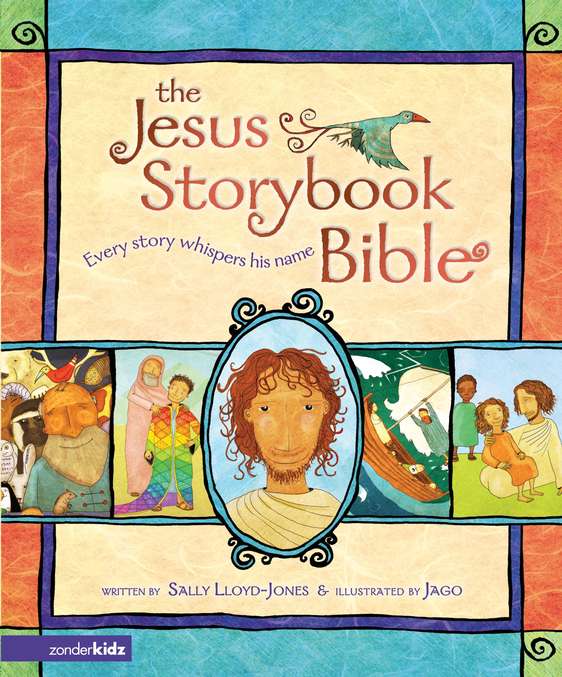
Book Review: the Jesus Storybook Bible

“Many years later, another Son would climb another hill, carrying wood on his back.  Like Isaac, he would trust His Father adn do what his Father asked.  He wouldn’t struggle or run away.

Who is He? God’s Son, his only Son – the Son He loved.

The Lamb of God.”

– from the narrative of Abraham and Isaac (Genesis 22)

Almost 3 years ago I was a completely overwhelmed soon to be father charged with the task of properly raising his children and showing them the truth of the Gospel.  As any parent [in this situation] does I began to seek help in the form of childrens’ Bibles.  I was convinced I could begin the Westminister [shorter] catechism after their first birthday and my wife was truly worried.  We were given a slew of childerens’ Bibles and resources that over the last couple years and I have throughly frustrated with the vast majority of them, even to the point of taking a sharpy to a few of them because they were heterodox (to say the least).

*Fast Forward*

With the birth of our second child a close friend (who had heard many a rant on the insufficiencies of children resources) purchased a certain children’s Bible for our kids. This friend has been a wonderful resource in the past, so even though our kids have no shortage of Bible books, we went ahead and added this to their repertoire.  I can now excitedly say that The Jesus Storybook Bible: Every Story Whispers His Name has been wonderful for the kids and for us, too.

One of the unique things about this version that I love is the Introduction.  Sally Lloyd-Jones, who developed The Jesus Storybook Bible, takes time to explain to readers what the Bible is and what the bible is not. They go on to explain the misunderstandings that “some people think the Bible is a book of rules…but the Bible isn’t mainly about you and what you should be doing.” They continue, “Other people think the Bible is a book of heroes” but explain that most of them have major flaws. This all leads up to one of my favorite excerpts:

“No, the Bible isn’t a book of rules, or a book of heroes. The Bible is most of all a Story. It’s an adventure story about a young Hero who comes from a far country to win back his lost treasure. It’s a love story about a brave prince who leaves his palace, his throne – everything – to rescue the one he loves. It’s like the most wonderful of fairy tales that has come true in real life!”

This has been one of the most creative resources I’ve read for children. It’s filled with magnificent and thoughtful illustrations and it doesn’t just help us teach our children the Bible, it teaches them how to read the Bible and how we fit into God’s story. What a wonderful gift to give our kids!  simply put parents, this resource is the single best I have seen to help kids discover the BIG PICTURE of the Bible.

If you have kids, want kids, think about kid, know people who have kids, work with of for kids please purchase this book.

[youtube=http://www.youtube.com/watch?v=v__QaCsdvQk&feature=player_embedded]

Homogeneous Unit Principle: Real World

I have worked within the service industry in some way, shape or form for (almost) all of my working life.  With this experience I have had the opportunity to encounter most expressions of culture here in the U.S.  These experiences seem hit a road block at most expressions of Christs’ family that I see.  It is truly difficult to see and understand how this principle works in the real world.

In the book entitles “The Bridges of God” McGavern states: ‘People become Christian fastest when least change of race or clan is involved’.  Additionally, in Understanding Church Growth, which he co-wrote with C. Peter Wagner, this observation has become the ‘Homogeneous Unit Principle’ which we have been discussing for the last few weeks.  Empirical evidence, they argue,  ‘people like to become Christians without crossing racial, linguistic or class barriers’. As a result homogenous churches grow fastest. Homogeneous churches are those in which all the members are from a similar social, ethnic or cultural background. People prefer to associate with people like themselves – ‘I like people like me’.  So we should create homogenous churches to be effective in reaching people.

McGavran’s analysis was largely based on rural missions in India where the caste system is normative, and where neighborhoods (villages) are usually cultural homogenous. He was observing how groups are transformed by the gospel. The transference of cultural homogeneity to urban contexts were neighborhoods are not culturally homogenous becomes more problematic.

Most churches are homogenous to some extent. People choose churches on the basis of worship-style, denominational allegiance, theological emphasis and even cultural background.  As soon as you choose to operate in one language you have created an homogenous group to some extent.  The real world result of this in the UK has been to leave significant sectors of the population untouched by the gospel. Likewise evangelicalism in America is largely middle-class, as a result our evangelism revolves around our friendships so excluding those outside our circle of acquaintance.  More significantly still, our church life and evangelism reflect a middle-class culture. Homogeneous groups do seem to be effective in evangelism, but they are by definition exclusive rather than inclusive.

Outside of the church this is not a normative practice.  Take for instance McDonald’s, $5bucks (a.k.a. Starbucks), or you fill in the blank you do not see people choosing said restaurants solely by there ,musical-style, food emphasis or even cultural background.  People go to these places to simply eat food.  I see most races represented at restaurants with messages much weaker than the Gospel yet they attract the diversity that the church lacks.  My main criticism of the homogenous unit principle is that it denies the reconciling nature of the gospel and the church.  It weakens the demands of Christian discipleship and it leaves the church vulnerable to partiality in ethnic or social conflict. It has been said that ‘the homogenous unit principles is fine in practice, but not in theory.  So my question for you is simply this:

  • Do you agree or disagree with the H.U.P.?
  • Why or why not?


Homogeneous Unit Principle: Jesus

** This post was supposed to go up yesterday and I scheduled it for the wrong day.  Sorry about the delay.**

“These twelve Jesus sent out, instructing them, “Go nowhere among the Gentiles and enter no town of the Samaritans, but go rather to the lost sheep of the house of Israel.” – Matthew 10:5 – 6


Why did Jesus asked his disciples not to go to the Gentiles? At this point of His ministry was He stressing Homogeneous Unit Principle it or was it simply that the time for the Gentiles to hear the gospel had not come yet? This specific instruction was made within a historical context rather than a cultural context, because Jesus himself was the first one to break the homogeneous line as we see Him at the very beginning of his ministry sharing the gospel with the Samaritan woman (cf John 4).

Historically Jews and Samaritans hated one another, and both Jesus and the woman knew it from the beginning of their dialogue.  Jesus’ action consists in destroying the wall of separation, in raising the centuries-old [self imposed] ban, in making communication possible between people separated by their ethnic, cultural and religious traditions.  Another great example of Jesus breaking this barrier was through His family line (cf Matthew 1:1 – 17).

Much to the astonishment of his disciples, Jesus deliberately broke all walls of separation. Interesting enough, Jesus went to Samaria after his meeting with Nicodemus, who was a Pharisee and member of the Jewish ruling council. He belonged to the people to whom Jesus came; however, Jesus did not revealed Himself to Nicodemus as the Messiah. Actually, the first time in His ministry He declared to be the Messiah and He did it to a person completely different from His homogeneous unit, to a person outside the chosen people and outside of her own society.

Another event that calls our attention is when Jesus openly declares what his ministry ought to be in Luke 4:14-30. Luke says that Jesus went to Nazareth, where he had been brought up, and went into the synagogue as was his custom. Jesus was not doing something unusual, people from that city knew him very well. However, when he declared to them that he is the Messiah, what happened? His homogeneous group, the people of his hometown (more than any people in Israel, this was his people) sought to kill him. This event shows that homogeneous unit is not enough for the acceptance of Christ.

Jesus began his ministry among the Jews in order to fulfill the covenant God made with Israel.  He initiated his movement in Galilee in order to fulfill the promise made in Isaiah 9:1-2.

Did Jesus worked along homogeneous unit? Studying his ministry (action) and teaching (words), there are strong evidences where homogeneous unit principle cannot stand.

We find in Matthew 8:21,22 and 10:35-39, that love for Jesus must be far superior to love for existing social ties. Love for family or people of origin is not equal than love for Jesus.

Homogeneous Unit Principle: Origins

I am a natural skeptic and as I came to Christ in 2002 and quickly began asking questions of any and everything I saw around me.  One question that I asked my pastor was “Why isn’t there more diversity of races within out church?”  You see I was one of the few black faces that I saw most Sundays.  At the time Johnson County [KS] was about 90% Caucasian but that still drove me to wonder about the lack of diversity within my church.  My pastor surprised me when he said, “Jon, it’s a thing called the ‘homogeneous unit principle’ that drives whether or not minorities come to our church.”  At the time this statement did not really bother me but as I began to research more about the [American] church and her history I became troubled.  This is the prod that began my juices flowing

Interviewer:  “[Dr. King] Don’t you feel that integration can only be started and realized in the Christian church, not in schools or by other means? This would be a means of seeing just who are true Christians.”

Martin Luther King:  “As a preacher, I would certainly have to agree with this. I must admit that I have gone through those moments when I was greatly disappointed with the church and what it has done in this period of social change. We must face the fact that in America, the church is still the most segregated major institution in America. At 11:00 on Sunday morning when we stand and sing and Christ has no east or west, we stand at the most segregated hour in this nation. This is tragic. Nobody of honesty can overlook this….”

This began my research into the Homogeneous Unit Principle and its origin. Donald A. McGavran (1897–1990) was former Senior Professor of Mission, church growth, and South Asian studies at the School of World Mission, Fuller Theological Seminary in Pasadena, California. A 3rd generation child of missionaries in India, and later a missionary himself.  Dr. Mc Gavran spent much of his life trying to overcome social barriers to Christian conversion. While in India McGaveran tried to understand , what forms people by economics and caste, substantially hinders the spread of Christianity.  From that work McGavran created a church growth text called, Understanding Church Growth, this book is still influential because of essays and lectures at missionary conferences in which he identified differences of caste and economic social position as major barriers to the spread of Christianity. His work substantially changed the methods by which missionaries identify and prioritize groups of persons for missionary work and stimulated the church growth movement.

The homogeneous unit is simply a section of society in which all the members have some characteristics in common. Thus a homogeneous unit might be a political unit (liberal/ conservatives) or sub-unit, the characteristic in common being that all the members live within certain geographical confines.

In his book McGavean says, “the homogeneous unit is an elastic concept, its meaning depending on the context in which it is used. However, it is a most useful tool for understanding church growth”.

Honestly his definition is not very clear mainly because he says that HUP is an elastic concept.  It is a broad definition. However it has been defined much more clearly.

“Such a section of society (HU) can be a culture or language, a tribe or caste, a clan or geographical unit. The members of a homogeneous unit think of themselves as enjoying a common bond of unity, simultaneously feeling different from other. The term is also frequently used as an adjective, such as in homogeneous unit church, meaning a church characterized by having members of just one social group.”

The HUP was born in McGavran’s mind out of the Indian system of caste. He experienced castes coming to Christ and still remaining a separated group. Also, behind his work in India there is the American culture with the individualistic worldview and the superiority of certain classes. This led him to say, “men like to become Christians without crossing racial, linguistic, or class barriers.”

  • Does your church abide by this?
  • What do you think of this concept?

How Can I Glorify God?

I imagine many readers of this blog want to bring glory to God with their lives. The chief end of man, after all, is to glorify God and enjoy him forever. But have you ever thought about how to glorify God—I mean practically in every day life?

Here are twenty biblical ways you can.

1. Give God verbal declarations of praise (Rev. 4:8-9).

2. Live a life of noticeable piety (Matt. 5:16; James 1:27; 1 Peter 2:12).

3. Ask God for things in Jesus’ name (John 14:13).

4. Bear fruit and show yourself to be a disciple of Jesus (John 15:8).

5. Declare the truth about Jesus (John 16:14).

6. Love your life less than God (John 21:19; 1 Peter 1:7; 4:16).

7. Worship God as God (Rom. 1:21).

8. Live a life of sexual purity (1 Cor. 6:20).

9. Live a life of generosity (2 Cor. 9:13).

10. Rejoice in God’s glory displayed in creation (Psalm 19:1).

11. Do the works of faith (2 Thess. 1:12).

12. Use your gifts in God’s strength (1 Peter 4:11).

13. Make sure everyone knows you’re not God (Acts 12:23).

14. Live a life of gratitude (Psalm 50:23; 2 Cor. 4:15).

15. In matters of liberty, seek the good of others (1 Cor 10:31).

16. Extend grace to sinners (2 Cor. 8:19).

17. Be a part of a local church (2 Cor. 8:23; Eph. 3:20-21).

18. Tell God you are wrong and he is right (Josh. 7:19; Jer. 13:16; Rev. 16:9).

19. Obey God (Lev. 10:3; Mal. 2:2).

20. Go from a Christ-despiser to a Christ-worshiper (Gal. 1:24).

Do you struggle with any of these?  What do you need to change?  What would you add to the list?

HT: Kevin DeYoung

  • « Previous Page
  • 1
  • …
  • 14
  • 15
  • 16
  • 17
  • 18
  • …
  • 22
  • Next Page »

Soma Community Church

804 Fairmount Blvd
Jefferson City, MO 65109
(573) 635-4832

Click Here for Mailing Address

Get Connected

  • 10 Year Anniversary
  • New Here
    • FAQ/ Location
    • About Us
    • What We Believe
    • Our Leadership
    • Our Name
    • Affiliations
  • Get Involved
    • Baptism
    • Rooted (College Ministry)
    • Covenant Membership
    • Events
  • Blog
  • Sermons
  • Giving
  • Contact Us

Copyright © 2025 ·SOMA Community Church · Website by Megaphone Designs