Soma Community Church

Gospel/ Family/ Mission

  • 10 Year Anniversary
  • New Here
    • FAQ/ Location
    • About Us
    • What We Believe
    • Our Leadership
    • Our Name
    • Affiliations
  • Get Involved
    • Baptism
    • Rooted (College Ministry)
    • Covenant Membership
    • Events
  • Blog
  • Sermons
  • Giving
  • Contact Us

why I [need to] write

Not that you asked but here you go…

Why I write?

  • I’m more of a verbal person than a literary one, but still I found out that sometimes I had to write about my faith and thoughts to explain it to others in my world.
  • Is this really necessary?  I think so, though it sounds kind of silly, I’m aware of that. But really it was a part of getting the message across.  I try to keep a journal to accompany many of the thoughts that I am constantly having so that I can convey them later.
  • Blogging makes me be a better writer. Writing is a skill that needs to be practiced and I need to practice it more often.  If someone just thinks about writing they are a thinker, not a writer, by committing to this blog, it forces me to fine tune my abilities.
  • Writing forces me focus. I customize every talk I give, the presentations I give are constantly morphing from week to week based on what is happening in the world, the experiences I have, and the people I meet. Thus, many of my blog posts are directly related to crafting a presentation for an upcoming speech. It also makes me think about what is important to the audience, and not only about the things important to me.
  • The words might help someone.  If in some way something I put on here helps another person, then the time it takes to write is worth the effort.
  • Finally, the blog forces me to keep reading and learning. If you want to write you must be exposed to new ideas, thoughts, points of view and perspectives. Because I write this blog I must force myself to observe the world around me more. It is easy to get myopic and not seek inspirations.  This is an easy trap to fall into as a aspiring pastor but we must stretch ourselves.

Why I’m NOT watching the World Cup Final

If you have read any of my tweets over the last month the title may come as a surprise, but it is the truth.  I love the 2 picture of joy that these men have after scoring the game winning goal for there respective sides.  I’ve loved the competition over the last month and I am truly sad that it will end until 2014, but that is it.  To be completely honest it has taken me years to get to this point and I do not expect you to be here but I would ask that you consider joining me [especially if you are a Christ follower].  In this final a new [and first time] champion will be crowned at the World Cup on Sunday, when Spain meets the Netherlands in a final which has the potential to be a classic. Well-organized and experienced Spain that has the players to outplay most club teams around the world against a Dutch side that has strikers, wingers and midfielders capable of slicing through any defense (point and case Brazil). The first World Cup final to be staged on the African continent should be a memorable one if both teams bring their best game to Soccer City Stadium.  So with all of this build-up why (you ask) are you going to be missing the game?

1.  I have to work.  Ultimately, my allegiance is not to a sport (looking at you every American sport) but to my God who has asked me to serve my family.  Will I watch the score? Yes, why not?  I will not let it affect my interaction with my guest and utilizing the chance to speak the Gospel into there lives.  I did not ask off, and I could have, and

2.  It’s just a game.  We forget this in America everyday (Lebron free agency 2010), it is rather sickening when you think about it. I am not pointing the finger solely at you but myself also.  We find ourselves better able to recite the stats of a person who plays a game while in the same breath our pastors and leaders that I do not have time to read my Bible, or study/ memorize it.  The way we treat sports in the U.S. shows everyone else that this is much more important that God.  I am not saying that you should become a monk and hide from the rest of the world but make Him more important than everything else.  Furthermore, I used to be a person, when my team won or lost, let that game affect my emotional disposition for the rest of the day [week] depending on the game.  Listen, I love futbol as much as the next person.  i truly think that it is the every-mans game, but it is NOT God and can not serve at a sufficient one.  It is just a game.

3.  The game will be replayed on ESPN later.  When I come home that night from working a 13 hour day, I will sit down, when everyone else is asleep and enjoy the match.  Will I know the outcome? Probably?  Will I care? Nope.  Is it because I’m not rooting for anyone? Nope, I want Holland to win but I think Spain is the better side.  I just enjoy the game for the games sake.  I could watch it on my phone but I don’t want to take away from my guest experience where I work, so I’ll just watch it later.  My guest pay good money to come and watch a great show.  Additionally they, being mostly American, don’t care about the final and so I will not have the opportunity to discuss it with them and lastly, see point 2 (it’s just a game).

Like I said earlier I by no means am coming from a high and mighty position but I do want to offer something for you to think about.  As a Christ follower I am constantly given the chance to remind myself that He is ultimate and these other things (food, money, sports, relationships, education, sex, music, pets, [add yours here]) make poor gods that always leave me not only unfulfilled but abandoned in the end.  This is not just about the World Cup.  What is it for you?

A [simple] reason to watch the World Cup

[youtube=http://www.youtube.com/watch?v=jbn3rOPmR9w]

Seriously, if you haven’t watched a game you have missed out on arguably the best Cup for the US. There are only a few more games maybe you should check them out. Oh, what city/person had the best reaction? Comment below….

Confession Part 3: Black in my shoes

“You are the whitest black person I’ve ever met” or “I’m more black than you are”

Invariably either one or both of these comments are made in almost every environment I end up in.  Usually by (but not limited to) my Caucasian associates who feel comfortable enough with me to inform me on what they think about the way I choose to act on a daily basis.  I’ve heard it in church; work, from fellow pastors, classmates, even those that I thought that their knowledge of me was extensive enough not to make such an ignorant statement.  So here is my question to those statements:  What is Black?

So what is being black enough?  Is it based upon complexion?  Is it a question of heredity and genealogy, or culture and experience?   My children may be mistaken for being Hispanic, Hawaiian, biracial (which they are), and will be told that they looked like an Middle Eastern, so I suspect that one’s physical characteristics alone do not make someone black enough.  Moreover, in many respects, it makes me realize how ethnic classifications based on colors are misguided anyway.   Black America, in particular, not only consists of people with many variants of complexions, black culture consists of people whose racial heritage is a product and blend of the realities of sexual impropriety.

Honestly, I’ve become comfortable enough in my skin to say that I am sick and tired of these (and many more) examples being the standard for what the definition of being Black is. So, again, what is “black enough?”  My skin is brown, and this makes me subject to the same racism that any other person in America has faced.  There are areas where I can’t walk without being stopped by the police.  Likewise, what is “acting white?”  There is not a manual that says all black people are supposed to have the same tastes when it comes to clothes, food, music, or anything else.  Am I not black because I can appreciate Vivaldi or Mozart as well as James Brown or Public Enemy?  Does my respect for education, learning and  knowledge mean that I am “acting white?” Notwithstanding my personal likes and dislikes, I am still black!  Though I can appreciate things about American culture that appear to be characteristically white, I also appreciate my black culture, history and heritage.  All in all, “blackness” is undoubtedly in the mind of the beholder.  The next time that you are questioning whether or not someone is “black enough,” consider that they may be asking the same about you.

This is purely hypothetical, but perhaps Malcolm X asked whether Martin Luther King was “black enough” when King was preaching nonviolence.  Maybe W.E.B. Dubois questioned the “blackness” of Booker T. Washington when Washington gave his address at the Atlanta Exposition.  Though these men may have had philosophical differences on how to empower blacks, one thing that they all had in common was appreciation for their heritage, the desire to take part in the ongoing struggle for freedom, respect for hard work and education, and a strong desire to unify and edify the black community’s social and economic status in an unequal America. Their lives epitomize the fact that individuals can succeed at using different methods to help blacks in their struggle for equality, and this truth really makes the question of whether or not someone is “black enough” meaningless.

Ultimately, what defines me is not the color of my skin, or the content of character but the God I serve.  But we will tackle this in the next part of my confession.  Tell me what you think below

**You should also read “Confession Part 1: My Story” and “Confession Part II: My Calling” **

Book Review: Free at Last

For years I’ve enjoyed the teaching of Dr. Tony Evans on his radio program: The Urban Alternative.  Dr. Evans has a amazing ability to draw illustrations to the Scriptures that draw you in to seeing the deeper truths of the Bible.  If you’ve ever look in the mirror frustrated, or even disgusted, by what you see, feeling locked in the image staring back at you (a person who continually fails sometimes even five minutes after you just vowed you wouldn’t do that “thing” again) or weighed down by the weight of a past pain or hurt which not enough time or prayer has been able to heal, or wondering if you will ever “be more” or “measure up,” then this book is for you. Dr. Evans explores the problem of Christians who continue to sin and who do not fully utilize the freedom they have received in Christ.
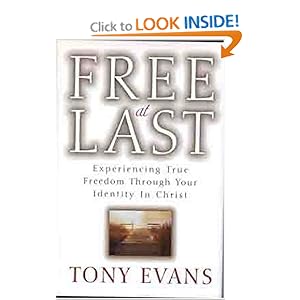
He compares Satan to a plantation owner who knows that legally his slaves have been freed, but who tries to convince them that they’ll never make it in this world without him. He says that sometimes we need to make it to rock bottom before we realize who Christ isin our lives.  Many Christians know they are free from the eternal penalty of their sins, but they are still in bondage to sin on this earth. Dr. Evans reveals how Satan has skillfully used that lie to hold Christians in a prison from which Christ has already set them free. He also shows you how to maintain your freedom once you realize it. It’s already yours, you just need to realize it, believe it and live it.  “Free at Last” is an inspiring and encouraging book, both for those who have not confessed Christ and for those who have been Christians for many years.

Plowing in today’s world

Langston Hughes was a poet born in Joplin, MO and lived many of his years in Lawrence, KS. He was a driving force during the Harlem renaissance of the 1920’s and 30’s and accomplished playwright. Hughes and his contemporaries were often in conflict with the goals and aspirations of the black middle class. The primary conflicts were the depiction of blacks in the lower social-economic strata, the superficial divisions, and prejudices based on skin color within the black community. Hughes was unashamedly black at a time when it was unfashionable. His main concern was the uplift of his people, whose strengths, resiliency, courage, and humor he wanted to record as part of the general American experience. Thus, his poetry and fiction centered generally on insightful views of the working class lives of blacks in America. I wanted to bring you this poem that, in my mind, captures what we should be thankful for during this holiday. Though Langston may not have fully known that what he was writing, this poem is not just for the common man, but truth of our undeserved grace and freedom, given by Christ, that is present in our lives.

FREEDOM’S PLOW
When a man starts out with nothing, when a man starts out with his hands empty, but clean, When a man starts to build a world, He starts first with himself and the faith that is in his heart- The strength there, The will there to build.
First in the heart is the dream- Then the mind starts seeking a way. His eyes look out on the world, on the great wooded world, on the rich soil of the world, on the rivers of the world. The eyes see there materials for building, See the difficulties, too, and the obstacles. The mind seeks a way to overcome these obstacles. The hand seeks tools to cut the wood, To till the soil, and harness the power of the waters. Then the hand seeks other hands to help, a community of hands to help- Thus the dream becomes not one man’s dream alone, but a community dream. Not my dream alone, but our dream. Not my world alone, but your world and my world, belonging to all the hands who build.
A long time ago, but not too long ago, Ships came from across the sea bringing the pilgrims and prayer-makers, adventurers and booty seekers, Free men and indentured servants, Slave men and slave masters, all new- To a new world, America!
With billowing sails the galleons came, Bringing men and dreams, women and dreams. In little bands together, Heart reaching out to heart, Hand reaching out to hand, they began to build our land. Some were free hands seeking a greater freedom, some were indentured hands hoping to find their freedom, some were slave hands guarding in their hearts the seed of freedom, but the word was there always: Freedom.
Down into the earth went the plow in the free hands and the slave hands, in indentured hands and adventurous hands, turning the rich soil went the plow in many hands that planted and harvested the food that fed and the cotton that clothed America. Clang against the trees went the ax into many hands that hewed and shaped the rooftops of America. Splash into the rivers and the seas went the boat-hulls that moved and transported America. Crack went the whips that drove the horses across the plains of America. Free hands and slave hands, indentured hands, adventurous hands, white hands and black hands held the plow handles, ax handles, hammer handles, launched the boats and whipped the horses that fed and housed and moved America. Thus together through labor, all these hands made America.
A long time ago, but not too long ago, a man said:
“ALL MEN ARE CREATED EQUAL–ENDOWED BY THEIR CREATOR WITH CERTAIN UNALIENABLE RIGHTS–AMONG THESE LIFE, LIBERTY AND THE PURSUIT OF HAPPINESS.”
His name was Jefferson. There were slaves then, but in their hearts the slaves believed him, too, and silently too for granted that what he said was also meant for them. It was a long time ago, but not so long ago at that, Lincoln said: “NO MAN IS GOOD ENOUGH TO GOVERN ANOTHER MAN WITHOUT THAT OTHER’S CONSENT.
There were slaves then, too, but in their hearts the slaves knew what he said must be meant for every human being- Else it had no meaning for anyone.
Then a man said:
BETTER TO DIE FREE THAN TO LIVE SLAVES
He was a colored man who had been a slave but had run away to freedom.
And the slaves knew what Frederick Douglass said was true.
In those dark days of slavery, guarding in their hearts the seed of freedom,
The slaves made up a song:
Keep Your Hand On The Plow! Hold On!
That song meant just what it said: Hold On! Freedom will come! Keep Your Hand On The Plow! Hold On! Out of war it came, bloody and terrible!
But it came!
Some there were, as always, who doubted that the war would end right, that the slaves would be free, or that the union would stand, but now we know how it all came out. Out of the darkest days for people and a nation, we know now how it came out. There was light when the battle clouds rolled away. There was a great wooded land, and men united as a nation.
America! Land created in common, Dream nourished in common,
Keep your hand on the plow! Hold on! If the house is not yet finished,
Don’t be discouraged, builder! If the fight is not yet won, don’t be weary, soldier!
The plan and the pattern is here, woven from the beginning Into the warp and woof of America:
ALL MEN ARE CREATED EQUAL.
NO MAN IS GOOD ENOUGH TO GOVERN ANOTHER MAN WITHOUT HIS CONSENT.
BETTER DIE FREE, THAN TO LIVE AS SLAVES.

Who said those things? Americans! Who owns those words? America! Who is America? You, me! We are America! To the enemy who would conquer us from without,
We say, NO!
To the enemy who would divide And conquer us from within,
We say, NO!
FREEDOM! BROTHERHOOD! DEMOCRACY!
To all the enemies of these great words: We say, NO!
A long time ago,
An enslaved people heading toward freedom
Made up a song: Keep Your Hand On The Plow! Hold On!
The plow plowed a new furrow across the field of history. Into that furrow the freedom seed was dropped. From that seed a tree grew, is growing, will ever grow. That tree is for everybody, for all America, for all the world. May its branches spread and shelter grow
Until all races and all peoples know its shade.
KEEP YOUR HAND ON THE PLOW! HOLD ON!

  • « Previous Page
  • 1
  • …
  • 11
  • 12
  • 13
  • 14
  • 15
  • Next Page »

Soma Community Church

804 Fairmount Blvd
Jefferson City, MO 65109
(573) 635-4832

Click Here for Mailing Address

Get Connected

  • 10 Year Anniversary
  • New Here
    • FAQ/ Location
    • About Us
    • What We Believe
    • Our Leadership
    • Our Name
    • Affiliations
  • Get Involved
    • Baptism
    • Rooted (College Ministry)
    • Covenant Membership
    • Events
  • Blog
  • Sermons
  • Giving
  • Contact Us

Copyright © 2025 ·SOMA Community Church · Website by Megaphone Designs