Soma Community Church

Gospel/ Family/ Mission

  • 10 Year Anniversary
  • New Here
    • FAQ/ Location
    • About Us
    • What We Believe
    • Our Leadership
    • Our Name
    • Affiliations
  • Get Involved
    • Baptism
    • Rooted (College Ministry)
    • Covenant Membership
    • Events
  • Blog
  • Sermons
  • Giving
  • Contact Us

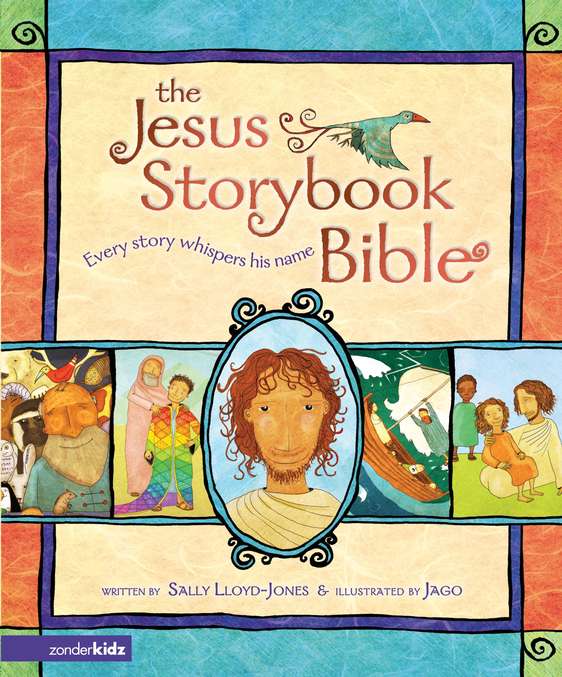
Book Review: the Jesus Storybook Bible

“Many years later, another Son would climb another hill, carrying wood on his back.  Like Isaac, he would trust His Father adn do what his Father asked.  He wouldn’t struggle or run away.

Who is He? God’s Son, his only Son – the Son He loved.

The Lamb of God.”
– from the narrative of Abraham and Isaac (Genesis 22)

Almost 3 years ago I was a completely overwhelmed soon to be father charged with the task of properly raising his children and showing them the truth of the Gospel.  As any parent [in this situation] does I began to seek help in the form of childrens’ Bibles.  I was convinced I could begin the Westminister [shorter] catechism after their first birthday and my wife was truly worried.  We were given a slew of childerens’ Bibles and resources that over the last couple years and I have throughly frustrated with the vast majority of them, even to the point of taking a sharpy to a few of them because they were heterodox (to say the least).

*Fast Forward*

With the birth of our second child a close friend (who had heard many a rant on the insufficiencies of children resources) purchased a certain children’s Bible for our kids. This friend has been a wonderful resource in the past, so even though our kids have no shortage of Bible books, we went ahead and added this to their repertoire.  I can now excitedly say that The Jesus Storybook Bible: Every Story Whispers His Name has been wonderful for the kids and for us, too.

One of the unique things about this version that I love is the Introduction.  Sally Lloyd-Jones, who developed The Jesus Storybook Bible, takes time to explain to readers what the Bible is and what the bible is not. They go on to explain the misunderstandings that “some people think the Bible is a book of rules…but the Bible isn’t mainly about you and what you should be doing.” They continue, “Other people think the Bible is a book of heroes” but explain that most of them have major flaws. This all leads up to one of my favorite excerpts:

“No, the Bible isn’t a book of rules, or a book of heroes. The Bible is most of all a Story. It’s an adventure story about a young Hero who comes from a far country to win back his lost treasure. It’s a love story about a brave prince who leaves his palace, his throne – everything – to rescue the one he loves. It’s like the most wonderful of fairy tales that has come true in real life!”

This has been one of the most creative resources I’ve read for children. It’s filled with magnificent and thoughtful illustrations and it doesn’t just help us teach our children the Bible, it teaches them how to read the Bible and how we fit into God’s story. What a wonderful gift to give our kids!  simply put parents, this resource is the single best I have seen to help kids discover the BIG PICTURE of the Bible.

If you have kids, want kids, think about kid, know people who have kids, work with of for kids please purchase this book.

[youtube=http://www.youtube.com/watch?v=v__QaCsdvQk&feature=player_embedded]

Book Review: Shepherding the Church

Dr. Joseph M. Stowell III, D.D. is best known for his long-standing presidency at Moody Bible Institute in Chicago, Illinois where he served from 1987 – 2005.  Currently Dr. Stowell serves as the president of Cornerstone University where he began his current tenure on February 1, 2008.  Prior to accepting the presidency at Cornerstone University, he also served as a Teaching Pastor at Harvest Bible Chapel in Elgin, Illinois.  Additionally, he continues to serve on the Board of the Billy Graham Evangelistic Association and works with RBC (Radio Bible Class) Ministries in Grand Rapids, partnering in media productions. As of 2010 Dr. Stowell has written over 20 Christian books and is an outspoken advocate for evangelicals worldwide.  Dr. Stowell received a Master of Theology. in New Testament studies from Dallas Theological Seminary and an honorary doctorate of divinity degree from Master’s College. He completed his undergraduate work as an English literature major at Cedarville University in Cedarville, Ohio.  Amongst all of the honors and achievements Dr. Stowell is first and foremost a faithful Christ follower, husband, father, and grandfather.

“…we who are called to spiritual leadership need to expect more of ourselves and hold ourselves accountable to scriptural standards rather than societal opinions. The biblical perspective on effectiveness in leadership consistently regards character as the essential prerequisite.”  This statement b y Dr. Stowell shapes the overall direction and heart of this book written to those within Christian leadership.  Throughout this 12-chapter book Stowell deals with both heart and practical aspects of ministry and attempts to address basic questions that most Pastor/ Elders ask at some time in their ministry.  Many times the questions asked include (but are not limited to), how do I prove to my congregation that I am trustworthy?  How do I lead by loving?  How do I overcome insecurities?  How can I transform lives with my preaching?  How do I lead my flock by the way I live my life? How do I persevere?  These questions, and many more, plague the pastor and in this book Dr. Stowell begins to address the foundations which lead many pastors into fruitfulness or could lead them to stray.

In order to touch on each subject matter Stowell breaks them into 4 main sections:

  • Part 1: Perspective: Perplexities, Priorities, and Platforms
  • Part 2: Personhood: Character still counts
  • Part 3:  Proclamation: Transformational Preaching
  • Part 4: Proficiency: Finishing Well

In doing this Stowell is able to take a look at what it takes to be a truly effective leader from the inside out.  Throughout the book he continually encourages today’s leaders to focus on their own character, spiritual growth, and spiritual gifts.  Given the current climate of clergy within our context Stowell encourages spiritual leaders to be more concerned with their character. Additionally he states, “This is a world where it’s not what you are as a person that counts, but it’s what title you hold, what floor your office is on, and what your business card looks like.”  Overall, the book deals with what the author calls “the core of ministry” while addressing the type of person one must be to shepherd and what areas they must be proficient.

In order to truly focus on issues with ministry Stowell immediately begins the book by dealing with the intrinsic change of our culture and the decline in doctrine within the church.  Stowell says no matter what the culture may like, the shepherd is to lead the church in three functions: evangelism, identification, and discipleship. If a shepherd strives to do this – the “best things” – then he is truly successful.  Although this is a great beginning to a text on pastoral leadership Dr. Stowell overlooked the opportunity to show how contextualization of the Gospel message is not something that cannot be directly contributed to the decline of the overall culture.  In leading church, central to one’s calling is the proclamation of the gospel in words and works of grace.  Leaders within the church context are called to represent Jesus, do the things of Jesus, and tell others about Jesus but to do this in culturally relevant ways.  While one can see Dr. Stowell trying to appeal to a larger audience by moving around the contextualization of the Gospel he unintentionally lends weight to the argument of not doing that same work.  A clear and orthodox understanding of the Gospel is essential, when it comes to the Gospel a pastor will not innovate, but when it comes to culture, however, a pastor seeks to continually be innovative in their means of communication.  A Pastor/ Elder not leading his congregation in a way that is orthodox yet contextually relevant or vice versa ultimately leads to the skewing of the foundational message of the church.  In turn the church is ever so slightly lead away from her mission and subtly turned towards one of many non-essential focuses.  Dr. Stowell’s very life and ministry shows that the Gospel must always be delivered into a specific cultural context thus showing that his intentions were not to lend weight to said argument.  The Pastor/ Elder’s call is to be culturally relevant while taking the unchanging Gospel into ever-changing cultures.  One does this by listening to and understanding the culture, learning to speak their language, connecting the Gospel to the idols of the culture, and showing the beauty and supremacy of Jesus.

In the next major section Dr. Stowell acknowledges that most pastors will feel wholly inadequate for the task at hand.  Stowell says, “when He gave us the task of carrying out the work of His church, He also graciously supplied supernatural enablement for us to carry out the assignment. In the midst of all of our insecurities, we must remember that He empowers us with enabling gifts of ministry.” A huge part of this assignment is what Stowell calls “Target 1”: to prepare people for works of ministry. In one of the strongest portions of this book Stowell relays a truly wonderful story about how a good shepherd will make an impact for Christ.  He tells the story of how D.L. Moody brought a man named Wilbur Chapman to the Lord and Chapman eventually led baseball star Billy Sunday to the Lord.  Through Billy Sunday’s thriving ministry, a man named Mordecai Hamm came to a saving grace, and through his obedience to preach he led a young man named Billy Graham to Christ!  The amazing thing about this story is how a shoe clerk named Edward Kimball in a stockroom saved Moody. No one knows the name of Kimball’s pastor, and that was not the point of Stowell’s story, but this chain illustrates how Pastor/ Elders are simply called to be effective shepherds by means of our consistent faithfulness, not by seeking to build a fiefdom through numbers and/or accolades. 


The next section of the book is shaped around one central question.  How do we show our faithfulness to those we serve?  In asking this question Stowell is assuming faithfulness to Jesus and submission to the Spirit as one serves in ministry.  The answer that emerges was simple yet complex to implement within our culture.  Stowell’s answer is: We show faithfulness by modeling the truths we preach and by serving our congregation.  In his opinion this is the essential work of a true shepherd.  Stowell gives some warnings of some of the things along this path there are great dangers to avoid, and like every good preacher and major section of this book there is alliteration, work, women and wealth. These temptations, along with a myriad of others, act as potential blights on a shepherd’s character, and character is absolutely essential. Character includes maintaining loving relationships and Stowell calls this “leading through loving”. Thankfully, Stowell dedicates a whole chapter to the issue of purity within the ranks of Pastor/ Elders. 


Section Three is entitled “Proclamation: Transformational Preaching” is a very important section for shepherds in the modern era to understand. Unfortunately this section was glossed over as far as depth.  In Stowell’s defense there are innumerable subjects to tackle, yet he did name three in particular materialism, individualism, and pragmatism.  Though he does state that we must overcome these aspects of our culture the praxis was sorely missed. Africa is currently dealing with an export of American Christendom; namely prosperity theology/idolatry. This erroneous teaching states that the truly holy and faithful will be blessed with financial prosperity. The epicenter of this error is American greed, materialism, and consumerism, and the proclivity of some to present Jesus as the one who gives us our idol of Mammon/Money.  Further, confounding this theological error is promoted around the world on “Christian” television and radio. The effects in the U.S. are damaging, and that damage continues around the world, particularly plaguing poorer nations where uneducated promise a hundredfold return on investment to their impoverished flock because it is what they learned from American preachers.  Additionally, we look back at the idols of the Enlightenment: the elevation of human reason, the belief that reason/science will solve all the world’s problems. Today we see the idol of individualism.  Enlightenment philosophy, while not completely evil, has taken the human gaze off of the divine and focused on us.  We attack Western individualism, but in many traditional cultures family is an idol—so you have honor killings, women treated as property, etc. In individualistic cultures like our own, the individual is an idol.  No one can tell anyone else they are wrong; no one can impose their beliefs about God on anyone else. Any ideology can be an idol: free-market economics, communism, socialism, democracy, liberalism, etc. and individualism is ours.  Lastly, many churches in North America have given in to the sin of pragmatism.  They have a pragmatic approach to ecclesiology that focuses on church growth more than on church health, and on cultural accommodation rather than biblical faithfulness.  Some churches have either adopted a hierarchical structure that resembles a corporate business, or they simply have no church structure at all. The result is that many churches produce consumers and not radical disciples of Jesus Christ. The truth is that church structure is extremely important for the overall health of a local church and the discipleship process. Church leaders can use church growth principles to add people to the church; however, only the gospel can grow people into disciples of Jesus Christ.  While Dr. Stowell would agree with these assertions, the exclusion of the depth of ideals was curious within a book that is focused on pastoral leadership.  Understanding that Dr. Stowell can not cover all aspects of this subject but is trying to touch on what he sees to be the main things within leadership.

In the last section Dr. Stowell touches on a subject that is not covered much within Christian circles, unless someone is arguing the five points of Calvinism, and that is the subject of finishing well.  This is by far the most important and powerful part of this text.  Statistically only 30% of leaders in the Bible finished well which means that 70% fell short of God’s plan for their lives.  This fact should jolt any present day leader who desires to count for God. These leaders will either end up

  • Running: Abraham, Joshua, Daniel, Paul and Peter enjoyed deepening intimacy with God throughout life.
  • Walking: Other leaders were slowed down in their ministry because of sin. They fell short of what God intended for their lives. The ramifications of disobedience to God at some point in their leadership continued to plague them, even though they may have been walking with God at the end. Such persons may include David, Jehoshaphat and Hezekiah. 


  • Limping: These leaders finished the race in poor shape. They were on a decline in the latter phase of their ministry.  Leaders in this category include Gideon, Eli and Solomon.

  • Disqualified:  Some leaders were taken out of the race prematurely. They were removed from leadership by assassination, killed in battle, denounced or overthrown.  God removed leaders such as Samson, Absalom and Ahab because He was not pleased with them.

A Pastor/ Elder must lead with the end in mind. As a leader one must expend a lot of thought into how one will finish the work God has entrusted.   Most people are only worried about how we are going to get to the next phase of our life, when the concern should well be how God is honored.

Overall, the wisdom included within these pages is hard to find and rare in this shallow culture.  In beginning to read this book one my think it would denounce church growth concepts and advocate a return to ineffective methodologies of a by-gone era, given the background of Dr. Stowell it would be easy to expect it.  Instead, what you will find within the pages of this book is a very helpful, relevant and insightful work that offers practical tips for the 21st century pastor.  Though it my not reach the level of “Lectures to my students” by Charles Spurgeon, Dr. Stowell’s book does a great job of addressing some of the needs of this generation of shepherds.  In the end, this book should be commended to anyone looking to enter the Pastoral ministry as a great reference resource that deals cultural trends in a biblical, refreshing and concise manner.

Book Review: Free at Last

For years I’ve enjoyed the teaching of Dr. Tony Evans on his radio program: The Urban Alternative.  Dr. Evans has a amazing ability to draw illustrations to the Scriptures that draw you in to seeing the deeper truths of the Bible.  If you’ve ever look in the mirror frustrated, or even disgusted, by what you see, feeling locked in the image staring back at you (a person who continually fails sometimes even five minutes after you just vowed you wouldn’t do that “thing” again) or weighed down by the weight of a past pain or hurt which not enough time or prayer has been able to heal, or wondering if you will ever “be more” or “measure up,” then this book is for you. Dr. Evans explores the problem of Christians who continue to sin and who do not fully utilize the freedom they have received in Christ.
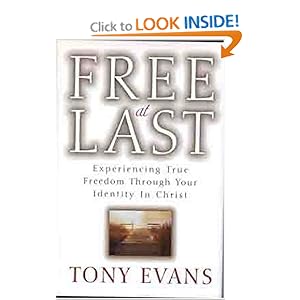
He compares Satan to a plantation owner who knows that legally his slaves have been freed, but who tries to convince them that they’ll never make it in this world without him. He says that sometimes we need to make it to rock bottom before we realize who Christ isin our lives.  Many Christians know they are free from the eternal penalty of their sins, but they are still in bondage to sin on this earth. Dr. Evans reveals how Satan has skillfully used that lie to hold Christians in a prison from which Christ has already set them free. He also shows you how to maintain your freedom once you realize it. It’s already yours, you just need to realize it, believe it and live it.  “Free at Last” is an inspiring and encouraging book, both for those who have not confessed Christ and for those who have been Christians for many years.

Book Review: Forgotten God

On my birthday my beautiful wife walked in the house with a few surprises from a local bookstore, one of them was the book Forgotten God: Reversing Our Tragic Neglect of the Holy Spirit by Francis Chan.  Chan, who just recently announced he’s leaving the church he help plant, is a radical teacher that doesn’t fit into any wooden description (such as liberal, or conservative).  Chan, who is mostly known for his book “Crazy Love” has also been teaching at numerous conferences and is a refreshing voice the culture of self promotion.  I believe he has been placed by God in this generation to wake the church up and invite us back to walking intimately with God.

In this book, he talks about the forgotten member of the Trinity: the Holy Spirit.  He rightfully asserts that differing beliefs concerning the Holy Spirit has caused some just not to teach on Him or strive to experience His presence in their lives today.  He is alive and waiting to be more apparent in our lives.  In seven easy to read chapters Chan covers the following topics:

  • The role of the Holy Spirit as Jesus’ promised gift.
  • Fears and concerns about the Holy Spirit
  • How theology about the Holy Spirit has more to do with how a person lives than what they say they believe.
  • Motivations around the Holy Spirit and his power.
  • What a relationship with the Holy Spirit can really be like.
  • Letting go of manipulation and control by trusting the Holy Spirit.
  • Living in true community with the Holy Spirit and with others.

For a book to be as hard hitting on these themes as it is, the tone Chan takes hardly comes across as a harsh reprimand. There is a pastoral gentleness and humility that flow through these chapters, possibly because the author often uses his shortcomings as examples. It is balanced with his unbridled passion for something better. It is a contagious proposition.  For readers who have already embraced the message from Chan’s first book, “Crazy Love,” you will find another winner here. For those who are reading him for the first time, you have found a new, encouraging friend, and Pastor.  Please pick this book up for yourself , small group, or for a friend, I highly recommend it.

Next Book Review will be next Wednesday May 19th…

The Reason for God @ Google

In this video Pastor Tim Keller is explaining the main ideas of his book, “The Reason for God” at the Google campus in Mountain View, California. Tim is someone who can calmly and knowledgeably share the Gospel with even the smartest most skeptical people.

[youtube=http://www.youtube.com/watch?v=Kxup3OS5ZhQ&feature=player_embedded]

I was inspired to share this with you because of an ongoing conversation I have been participating with some very intelligent non-Christian men about God. They ask me about my Bible while I’m at work and it set off an hour long conversation about why Jesus is the world’s only hope. Thankfully from listening and reading the teaching of wise Christian men, like Keller and Francis Schaeffer, I have been able to answer most of their questions about God. Listen to this talk and read his book—it will be worth it.

Soma Community Church

804 Fairmount Blvd
Jefferson City, MO 65109
(573) 635-4832

Click Here for Mailing Address

Get Connected

  • 10 Year Anniversary
  • New Here
    • FAQ/ Location
    • About Us
    • What We Believe
    • Our Leadership
    • Our Name
    • Affiliations
  • Get Involved
    • Baptism
    • Rooted (College Ministry)
    • Covenant Membership
    • Events
  • Blog
  • Sermons
  • Giving
  • Contact Us

Copyright © 2025 ·SOMA Community Church · Website by Megaphone Designs