Soma Community Church

Gospel/ Family/ Mission

  • 10 Year Anniversary
  • New Here
    • FAQ/ Location
    • About Us
    • What We Believe
    • Our Leadership
    • Our Name
    • Affiliations
  • Get Involved
    • Baptism
    • Rooted (College Ministry)
    • Covenant Membership
    • Events
  • Blog
  • Sermons
  • Giving
  • Contact Us

What would you die for?

By “give my life for,” I mean two things.  First, I give my life “for” them by giving my life to them.  The life that I now have the privilege of living, I endeavor to invest in these things.  That investment amounts to a slow dying for.  Second, I pray the Lord would strengthen me in any moment where I might be called upon to give my life “for” these things by dying more quickly, perhaps violently for them.  In those two senses of the phrase, here are eight things I would give my life for:

  1. God: The revelation of God as the only God, eternally Triune in nature and yet one, deserving all glory, honor, praise, and submission from His creation (Ex. 15:11; John 10:30; Acts 5:3-4).
  2. Scripture: The Bible as the inerrant, infallible, inspired, authoritative, sufficient, nourishing, life-giving word of God (Rev. 1:9).
  3. Jesus (okay I admit, this is a little redundant) : Jesus Christ, the only begotten Son of God, fully God and fully man, in whom dwells all the fullness of the Godhead bodily, the exact representation of God’s being and the radiance of His glory, apart from whom there is no salvation (Col. 2:9; Heb. 1:3; John 3:16).
  4. The Gospel: The good news that sinful man is saved from the justly deserved, holy, eternal wrath of God by God’s grace alone through faith alone in Christ alone, who in His perfect life and His substitutionary, penal atonement provides both our righteousness before God and satisfaction to God’s wrath, and to whom we are forever united by faith unto eternal life (Rom. 3:21-26).
  5. Missions: The call and work of going to all the world to make disciples of all nations and to teach them to observe everything Jesus commanded so that the glory, honor, praise, and worship of God through Christ would fill the earth and so that the joy, comfort, salvation, and hope of all peoples would overflow in Christ (Matt. 28:18-20; 2 Cor. 11:23-29).
  6. Discipleship (which includes Evangelism): My own personal profession of faith in and loyalty to Jesus Christ, the Son of God, God the Son, my Lord and Master, to whom I owe everything, for and in whom I live, breathe and have my being, and Who lives in me, completing the work He began until the day of His return, who will be perfectly and now is imperfectly my greatest and highest Delight and Satisfaction (Luke 9:23-26; Gal. 2:20; Acts 17:28; Phil. 1:6;  Ps. 17:15).
  7. My Family (surprised they aren’t higher?): The good thing and obtained favor of the Lord, my wife, who satisfies me with her love and comforts me with her presence, who is constant encouragement and whose virtue has made me known among the elders at the city gate, with whom I am an heir to life and a partner in the gospel of our Lord, and the arrows in our quiver, entrusted to us to raise as a godly offspring to the Lord, not to provoke but to bring up in the fear and admonition of the Lord, through whom we have no greater joy than to see them walking in the truth, who we pray represent one in what will be generations of godly Nelsons living for the Lord (Prov. 18:22; 5:18-19; Prov. 31; Ps. 128; Mal. 2:15; 2 John 4; 2 Tim. 1:5).
  8. The Church: Those bought by the blood of Christ, granted eternal life and the gift of the Holy Spirit, adopted into the family of God, joined together by covenant love, journeying as pilgrims to the Heavenly City, entrusted by God’s grace into mutual care and leadership to deliver as a chaste bride awaiting her groom (John 10:10-15;Col. 1:28-29; Rev. 21).

These are just the 8 I came up with off of the cuff while borrowing so language that is much better than mine. Do you think that I missed any? Let me know below in the comments.

Politics and the Debt Limit

I am not really a person who speaks about politics much but this was brilliantly done.  Check this out…

[youtube=http://www.youtube.com/watch?v=Li0no7O9zmE]

A dead spot in the room

As a pastor I find my self drawn to sit towards the front of every church service I’m in.  In fact, this past Sunday I noticed something rather curious.  Usually, I sit on the 3rd or 4th row with my wife.  I love being able to worship with her and I find that it’s is a valuable part of our relationship together.  The weeks that I preach I am left to attend a service (usually the 2nd) by myself, so I end up on the front row.  These are [supposedly] the best seats in the house, right?

You would think so, but it turns out that the way the speakers are positioned off of the ceiling, the sound waves shoot right past those of us on the front row.  This creates an annoying dead spot making certain parts of the mix (especially the lyrics) almost inaudible until about the fourth row back my normal seats.  Funny huh?  The people who are closest to the action have the hardest time hearing the lyrics.

Those of us who are on the front row of what God is doing (Pastors, Deacons, volunteers, etc) are in the greatest danger of having the sound waves shoot right over our heads.  That is we are so close to the action that we lose a sense of wonder and gratitude.  We see God do remarkable things day in and day out and we no longer hear the rumble and feel the vibrations of the workings of the Spirit.  Church leaders can often find ourselves with the best seats in the house, straining to hear the lyrics, in the dead spot on the front row.  Honestly, I find myself in this position more that I care to admit, straining to hear the Father while sitting closest to the action.  I don’t know the solution but I know that the first step is identifying the problem so I would love your thoughts.

Black Church: Call-Response

Linguist Geneva Smitherman, says the communication process of call-and-response – the spontaneous verbal and nonverbal interactions between speakers and audiences – is a fundamental organizing principle of African-American (AA) culture.  In plain English Call and response enables black people to achieve the unified or spiritual harmony that is basic to the traditional African worldview.  Honestly this was all lost on me as a child as I heard the shouts and moans of the crowd as they responded to the preacher and quickly surmised that it was all for show.  Unfortunately, on some levels I am right but at a deeper level there is a sense of cohesiveness that comes through call and response.

The function of call-and-response is to establish and maintain spiritual harmony, to maintain a sense of group solidarity, and cultural values.  However, the actual call-and-response patterns in AA culture and the typical affirmations utilized to encourage/ ensure active participation need to be examined.  The most popular technique occurs between the speaker, singer, or the audience of listeners. Entire phrases or verses are sung or spoken by the leader and repeated verbatim or altered somewhat by the audience or chorus. An example of this “leader and chorus” structure is illustrated in a most Kirk Franklin songs.  My wife and I have joked about these cultural differences but this is normative.  As with many black spirituals, a leader sings an entire verse, and then the others join with the leader to sing the chorus.

In black religious services, worshipers engage in more than simply acknowledging the sermon with an “amen” or like responses, they actually preach back.   The only observer in a AA worship service the only observer is God himself.  Having been apart of many different cultural expressions of church in America I have seen this first hand.  Additionally, the preacher makes statements that are frequently responded to before he completes his statement or thought.  This “overlapping”  and at its height the speaker and audience roles often shift with the audience doing most of the calling and the speaker doing most of the responding.   This is also reflected in African music, as well as in AA  music says  African scholar John Miller Chernoff, all of the musicians are playing “forward toward the beat” and “pushing the beat” to make it more dynamic.  This is what occurs in AA  religious services when the preacher adapts and employs every verbal response from the audience in a direct search for spiritual harmony. The vitality and rhythm of life is in the unified and collective response of the audience to the speaker.  In the end this seems like foolishness, or so I thought.  As I looked on to the spectacle of call and response I quickly came to the decision that this type of exuberance and loud proclamation was purely for show and not worship, yet as I  have grown older I have come to understand the rich history and unifying aspects of this part of my cultural background.

Black Church: Rhythm

It is Black History Month, and every year I try to celebrate by writing a series of articles that particularly pertain with my culture and her expression through Christ.  I must admit this relationship has not always been the most healthy for me, but over the years I have come to the conclusion of loving the heritage and culture I have been given.  Additionally, I wanted to start off by talking about some things I love about this culture.  Notice I am saying culture, this is not a racial thing because there are only two races: those who are saved and those who are not.  I just want to clarify this as I will intersperse those words throughout my writing moving forward.

RHYTHM

The poet Leopold Sedar Senghor, first president of the republic of Senegal, stated that rhythm is the “organizing force” that makes the black style.  Both Africans and African Americans use rhythm (not exclusively but uniquely)  to articulate their moral, theological, and philosophical beliefs. Rhythm, the essential and central element in black music, philosophically communicates “religious” experience in African and African-American culture and helps its ritual participants reach “communitas.”

Rhythm is particularly significant for rap because it gives rap its unique movement and momentum.  Tricia Rose sucessfully demonstrated through her research that the lowest or fattest beats in a rap song are likely the ones that the most philosophically significant or emotionally charged. Whereas Western music finds its uniqueness in melodic and harmonic structures, African American music finds its uniqueness in rhythmic and percussive structure.

I love the sounds inspired by the black community, whether those sounds come from gospel choirs, blues, Jazz, R & B, Soul, Neo-Soul, rap, or hip-hop.  Allow me to list three ways in which I am grateful.

  1. Gospel choirs: I grew up in a church that did them well.  The emotion, swaying, passion, heart are all things I sometimes miss on a Sunday morning.  Additionally, the spirituals, these are something that as I have grown older have grown closer to my soul.  The pure angst behind every word is still very evident to this day.
  2. Christian rap/Hip hop:  One of the most creative and faithful forms of worship to have arisen in recent years is Christian rap, with rappers like Shai Linne, Trip Lee, and Lecrae unleashing some of the most powerful and profound lyrics available in contemporary Christian Music today. I have to be honest this music saved me as I first became a Christian because most of CCM is acoustic guitar driven “soft rock” or ballets and I could not stand it.  May their tribe increase (I wish I were part of the tribe but it is not my calling).
  3. Mainstream Rap/Hip-hop:  While there is so much with which I disagree in mainstream rap and hip hop, those art forms within themselves have served as powerful venues to entire communities to express their beliefs, feelings, and values (both social and political.  Rap itself is an acronym for Rhythm and Poetry and gains its roots in pre-slavery African and serves a basis for most forms of “American”music that we know today.  Even when these artists’ music are consciously and profoundly non-Christian, the Christian community is well served to pay attention to these art forms as a way of loving and understanding a community that is usually so misunderstood yet rich with insight.

God’s not done with you!

I am not sure who I am writing this to but I feel led to let someone know GOD’S NOT THROUGH WITH YOU!

It has been weeks, (maybe) months, maybe even years you have bought into the lie that “it’s over” when it comes to you doing something great for God. After all, you committed __________________ and because of that there is no way He could ever use you, or at least that’s what you’ve been led to believe.

Let me both encourage you, be very clear and to the point: If God were done with you then He would have killed you. The very fact that you have air in your lungs right now means that HE IS NOT THROUGH WITH YOU!

You messed up? Of course you did, you’ve heard me say it multiple times.

“All of God’s children have problems! If you go somewhere where they claim (or act like) they don’t, RUN!”

This being true still is NOT an excuse to go out and continue a downhill slide, but rather a reminder that in the Bible the ONLY people God used were people who had messed up (like you) and were broken.

  • David committed adultery and murder (Think about it, David would not have been allowed to serve in or attend a lot of churches!). He also repented of his sin (see Psalm 51) and today we know him as “a man after God’s own heart!”
  • Moses killed a man and God used him to lead the nation of Israel out of Egypt to the border of the Promised Land.
  • Paul was a murderer and God used him to write most of the New Testament.
  • Peter denied Christ, chose to walk away from Him and God used him to preach on the Day of Pentecost where 3,000 people accepted Christ in one day!

I could go on and on, but [hopefully] you get the point, your past does not disqualify you from an amazing future if you are in Christ. Yes, there are consequences for our actions but we act as if God is surprised of our shortcomings. Trust me He is not.

God’s not through with you and if you don’t let your past die then it will not let you live . The consequences of not letting it die is allowing the enemy to talk you out of the amazing things God has planned for you.

When we repent of sin (which is the most powerful thing we can do in our walk with Christ) we become unstoppable. If you have fallen, sinned, and/or screwed up but have repented of sin, then please (for the love of God almighty) STOP believing the lie that there is no way God could use you! Please look at I Corinthians 6:9-11 now.

God’s not through with you! Get up, Get on your feet and do what He has called you to do.

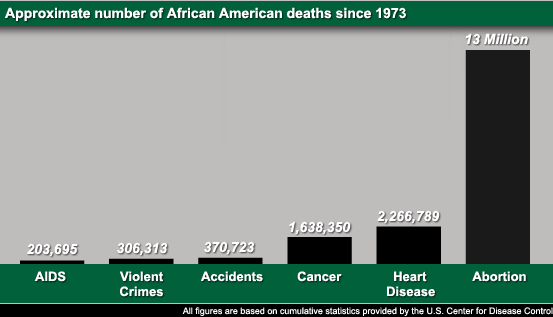
Black Genocide: the new racial slavery

**Update 2013: This post is from February 2012 but in light of Rev. Dr. Martin Luther King Jr. Birthday, President Obama’s Inauguration and the 40th anniversary of Roe vs. Wade I felt compelled to re-post this one so we can look at the reality of racial slavery in the United States.  I would love to hear what you think in the comments below.**

Unlike last year I have chosen to largely avoid the subject of Black History month (for many reasons), but if you would like to read those post please click here.  I did want to talk a subject that I did not have the opportunity to address last year and I feel is truly important to the Black community at-large.  The subject is abortion.  So let me put all of my cards on the table.  I am pro-life, anti-abortion, anti-choice or however you would like to frame it.  My view on this subject is shaped mainly by the Bible but also by my experience with family, friends, pastors, and professors that have had or have been the target of an abortion.  I am not sure that I can change your mind, or if that is even my purpose but my intent is to inform people of the realities of this issue.

Last February (Black History Month) this billboard was erected in the SoHo district of New York near one of Planned Parenthoods (PP) 3 located in the city.  Immediately there was a great outcry not only from PP but also the Black community.  To be completely honest I was taken back by the back lash. So here is some history.

We do not want the word to get out that we want to exterminate the Negro population, and the minister is the man who can straighten out that idea if it ever occurs to any of their more rebellious [church] members.

This quote is from Margaret Sanger who was a “reproductive rights advocate” and eventual founder of PP and was aware of concerns that birth control would pose a threat to the Black community.  Consequently, she was determined to alleviate these concerns by involving the African American community (specifically civic leaders, pastors) in the formation of birth control clinics in the South.  The quote above comes from a letter that Sanger wrote to Dr. Clarence J. Gamble, one of the financial backers of the birth control movement.  In the letter, Sanger argued that African American doctors needed to be employed at birth control clinics.  She felt that it was important to employ black doctors and social workers in order for patients to feel that the clinics represented their community.  When the Birth Control Federation of America became Planned Parenthood Federation of America in 1942, Sanger established the Division of Negro Service [context] to oversee outreach to the African American community nationally.  These seem nominal until you find that Sanger aligned herself with the eugenicists whose ideology prevailed in the early 20th century.  Eugenicists strongly espoused racial supremacy and “purity,” particularly of the “Aryan” race.  Eugenicists hoped to purify the bloodlines and improve the race by encouraging the “fit” to reproduce and the “unfit” to restrict their reproduction. They sought to contain the “inferior” races through segregation, sterilization, birth control and abortion.  Sanger embraced a certain type of eugenics called Malthusian eugenics. Thomas Robert Malthus, a 19th-century cleric and professor of political economy, believed a population time bomb threatened the existence of the human race.  He viewed social problems such as poverty, deprivation and hunger as evidence of this “population crisis.”  Malthus’ disciples believed if Western civilization were to survive, the physically unfit, the materially poor, the spiritually diseased, the racially inferior, and the mentally incompetent had to be suppressed and isolated—or even, perhaps, eliminated. His disciples felt the subtler and more “scientific” approaches of education,contraception, sterilization and abortion were more “practical and acceptable ways” to ease the pressures of the alleged overpopulation.

Why do I bring all of this old stuff up you may ask?  What does this have to do with PP today?

History can give us a great view of the trajectory of any person or organization.  Can a person or organization change?  Yes, I have, by God’s grace repented (implying a 180 degree change) and I am being remade through the grace of God.  Though PP has tried to distance themselves from Sanger the truth is that her mission seems to be alive ad well.  Whether on purpose or not I do not claim to know.

The Supreme Court in the Dred Scott case of 1857 held that Black slaves were property without rights as free persons, yet today we view that as unthinkable; so also even though the Supreme Court in the Roe v. Wade case of 1973 did not give the unborn the rights of free persons, nevertheless the day may come when that too is viewed as unthinkable. Racism might—and often did—result in the killing of innocent humans; in our history, it often did. But abortion always results in the killing of innocent humans. Between 1882 and 1968, 3,446 [known] Black people were lynched in America. Today more Black babies are killed by abortionists every three days than all who were lynched in those years (Life Education and Resource Network).

Today 78% of Planned Parenthood clinics are in minority communities. John Ensor takes this as the crucial challenge of the pro-life, crisis pregnancy center movement: Go to the urban centers. Here is what he says:

To date, the pregnancy center movement has grown mostly in rural and suburban areas. The great challenge now facing us is to respond to the abortion industry’s dominant business strategy of abandoning rural and suburban abortion facilities and targeting urban neighborhoods. For example, Planned Parenthood closed 17 abortion facilities in 2004. But they sold 20% more abortions. How did they do this? By targeting minority neighborhoods in major cites. Currently, 94% of America’s abortion facilities are in cities. And African-American women, who make up 13% of the female population account for 36% of all abortions.  Latino-American women makeup another 13% of the female population, but account for another 20% of all abortions. (See Susan Enouen, “Planned Parenthood Abortion Facilities Target African American Communities.”)

In other words, the de facto effect (I won’t call it the main cause, but net effect) of putting abortion clinics in the urban centers is that the abortion of Hispanic and Black babies is more than double their percentage of the population. Every day 1,300 black babies are killed in America. Seven hundred Hispanic babies die every day from abortion. Call this what you will—when the slaughter has an ethnic face and the percentages are double that of the white community, something is going on here that ought to make the lovers of racial equality and racial harmony wake up.

I simply want you to know where I am going, so that no one will say I made this association between abortion and racism in a sly or subtle way. It is not subtle. It is open and intentional and, I hope to show, justified. May God make the support of abortion in America and around the world as unthinkable as support for racism.

I don’t expect to escape misunderstanding or criticism for this message. But  few attacks might be avoided by quoting Randy Alcorn whose view I share:

I do not believe that most people who support abortion rights are racists, any more than I believe there are no racists among pro-lifers. I am simply suggesting that regardless of motives, a closer look at both the history and present strategies of the pro-choice movement suggests that “abortion for the minorities” may not serve the cause of equality as much as the cause of supremacy for the healthy, wealthy and white. (Eternal Perspectives, Sept.-Oct. 1993, p. 9)

Again my aim is to associate abortion and racism, not to equate them. Whether the association is justified, you will decide. It’s not a biblical declaration; it’s a cultural observation.

Listen, I know that abortion is a very touchy subject, and talking about it can result in anger and accusations.  Therefore, I pray that in this article I did not offend anyone needlessly or carelessly.  As a Christian, I believe abortion is wrong, but I will not point an angry condemning finger at anyone who has had an abortion.  The choice to have an abortion is not an easy or flippant decision.  It also is a decision that has been made by many of my friends and family, and had in no way diminish my love for any of them.

Others, I suspect, may be tempted to dismiss my comments because I am a Christian as well as a man.  I can only hope that if this is you that you will not do that and listen to the facts presented here.  Others may assume that I will try to condemn them and then use the Bible to bash and ridicule.  This was not my intent in any way, shape or form.  I reference the Bible, not as a club, but as a source of forgiveness and encouragement.  No one is cut off from Christ because of past sin – any past sin. What cuts a person off from Christ and the fellowship of his people is the endorsement of past sin. For the repentant there is forgiveness and cleansing and hope.” 2 Corinthians 7:9,10 says:

I now rejoice, not that you were made sorrowful, but that you were made sorrowful to the point of repentance; for you were made sorrowful according to the will of God, in order that you might not suffer loss in anything through us. For the sorrow that is according to the will of God produces a repentance without regret, leading to salvation; but the sorrow of the world produces death.

Reconciliation to God, through the blood of Jesus Christ, is the only way to overcome the tragedy of abortion, and though the sorrow of past sins can linger, the penalty will be forever lifted. If you have received this forgiveness, let the world know, and be a voice of warning to those thinking of talking the same path as you.

A knock at midnight

On February 4, 1968, these resounding words were heard at the Ebenezer Baptist Church in Atlanta, Georgia:

If any of you are around when I have to meet my day, I don’t want a long funeral. And if you get somebody to deliver the eulogy, tell them not to talk too long… Tell them not to mention that I have a Nobel Peace Prize—that isn’t important. Tell them not to mention that I have three or four hundred other awards—that’s not important. Tell them not to mention where I went to school… say that I was a drum major for justice. Say that I was a drum major for peace. I was a drum major for righteousness. And all of the other shallow things will not matter.  I won’t have any money to leave behind. I won’t have the fine and luxurious things of life to leave behind. But I just want to leave a committed life behind.  And that’s all I want to say.

Today, is the birthday of a man who so eloquently spoke those words.  I wanted to honor his memory, his trials, his triumphs, and his accomplishments.  The reluctant dreamer who dared to speak out against injustice, who dared to trod into hostile and violent territories for [racial] equality, who dared to preach hope for the hopeless.

Rev. Dr. Martin Luther King Jr. delivered many speeches and sermons in his short time in the national spotlight. Certainly, his words will be forever enshrined in print, audio, and even electronic materials. I have been to the mountaintop, I Have a Dream, Beyond Vietnam, How Long Not Long, are only a few titles was well known speeches and sermons delivered by him.  Each of them are inspiring with a very sharp edge if you are paying attention.   I think about the world in which we now live – some 84 years after his birth – there is one speech by Dr. King is both timely and powerful.
The sermon was called “A Knock at Midnight” and it is about the parable in Luke 11:5-6 where a lonely traveler knocks at someone’s door around the midnight hour to ask for food for a friend. What would you do? Dr. King says,

“It is also midnight within the moral order. At midnight colors lose their distinctiveness and become a sullen shade of gray. Moral principles have lost their distinctiveness. For modern man, absolute right and wrong are a matter of what the majority is doing. Right and wrong are relative to likes and dislikes…”

In listening to the words of this sermon,  I could not help but think  how prophetic he was.  His words are still very relavent today and I want to leave you words he spoke that night that should stir something deep within our souls today.

If the church does not recapture its prophetic zeal, it will become an irrelevant social club without moral or spiritual authority….But if the church will free itself from the shackles of a deadening status quo, and, recovering its great historic mission, will speak and act fearlessly and insistently in terms of justice and peace, it will enkindle the imagination of mankind and fire the souls of men, imbuing them with a glowing and ardent love for truth, justice, and peace.

Listen to the full sermon here or watch a clip below

[youtube=http://www.youtube.com/watch?v=0JFLjwAYHks]

What will shape your 2013

Happy New Year! 

As a New Year begins we have the chance to shape the trajectory not just for our year but [possibly] the rest of our lives.  I love the hope, anticipation, and confidence that this time of year brings.  Over the last decade that I’ve known my wife she has had this odd tradition of coming up with a yearly theme, as a matter of fact many of my friends have this tradition.  Some examples from the last few years are

  • “Dream Big”
  • “Ready or Not”
  • “Better Days”

This last year for us was “Blessed” because we can clearly see that God was walking us through this last year while working all things for His glory.  It is not a resolution, each theme represents what we hope to learn and experience from God in the year to come and it usually has a lot to do with the year before.  My theme this year is “Freedom”; Freedom in His Spirit, from debt, to live, to rest and for His glory.  This theme shaped a sermon I was able to give at Concord this last weekend entitled “Freedom!” from Galatians 5:1.  Though I was able to say I feel God used what I had to say to set someone free.

So I have a simple question, What word(s) defined 2012 and what words(s) do you pray define your 2013?

Top 5 Post of 2012

Before I kick off the new year of post, I would like to take a moment and look back at everything we discussed here in 2012.  In case you missed any of the most popular articles throughout the year, or if you just want to read them again, here are the 5 top posts on Neo Soul Faith of 2012:

  1. Change 

  2. Dear church people..I hate church

  3. Some additional Christian Pickup lines 

  4. Why I am intolerant…

  5. God will never give you more than you can handle?

  • « Previous Page
  • 1
  • …
  • 9
  • 10
  • 11
  • 12
  • 13
  • …
  • 30
  • Next Page »

Soma Community Church

804 Fairmount Blvd
Jefferson City, MO 65109
(573) 635-4832

Click Here for Mailing Address

Get Connected

  • 10 Year Anniversary
  • New Here
    • FAQ/ Location
    • About Us
    • What We Believe
    • Our Leadership
    • Our Name
    • Affiliations
  • Get Involved
    • Baptism
    • Rooted (College Ministry)
    • Covenant Membership
    • Events
  • Blog
  • Sermons
  • Giving
  • Contact Us

Copyright © 2025 ·SOMA Community Church · Website by Megaphone Designs